
Charlie Sam: Cute, Cool, Creepy, and Always Making Something
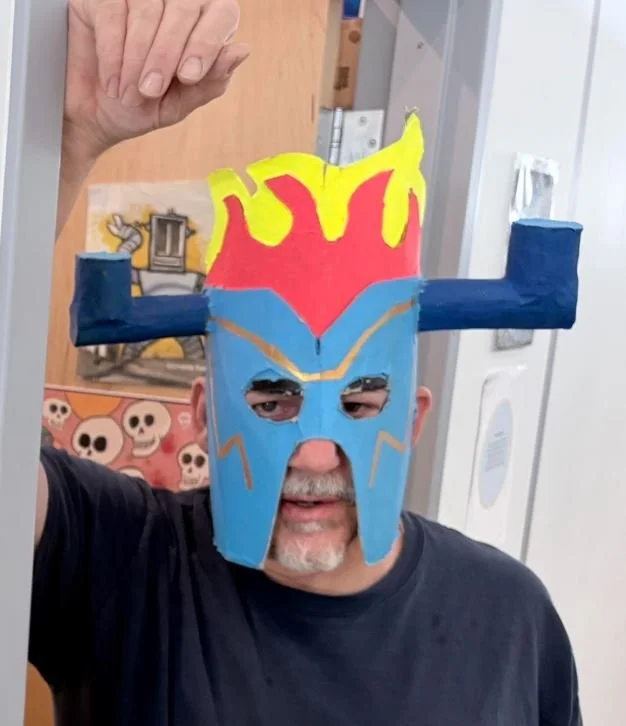
Photo Credit: HonGo David Robertson
On a Monday morning at the Gear Factory in Syracuse, New York, Charlie Sam sits surrounded by the accumulated evidence of a working artist’s life. There are drawings, paintings, stickers, wooden objects and the assorted materials that find their way into a studio where almost anything can become part of the next idea. Sam has been involved with the Gear Factory since 2007, and the building has become one of the two touchstones of his artistic life. The other is the Westcott neighborhood, where much of Syracuse’s creative energy has long found an outlet.
Sam is, by his own description, a full-time artist, although that description does not begin to cover the range of what he does. He makes paintings, drawings, graphic designs and murals. He creates characters that appear on T-shirts, hoodies, pint glasses, buttons and stickers. He builds small sculptures from discarded wood. He teaches workshops about copyright and papier-mâché. He helps organize exhibitions and promote other artists. And he continues to experiment.
“I have to make something all the time,” he says. When he cannot think of something to draw or paint, he makes small sculptures instead. The activity is less a choice than a way of working. There is always another material to explore, another character to develop, another object to turn into something unexpected.
Sam has lived most of his life in Syracuse. He was born in New York City, traveled to Europe with his mother when he was young, and came to Syracuse when he was about five. He has traveled since then, but Syracuse has remained his home base. His connection to the city is not simply geographic. It is tied to the people, buildings, neighborhoods and creative communities that have shaped his life as an artist.
His path into art began early. Sam says he started doing public art with chalk when he was “about 10 or 11”. For years he was essentially self-taught. Later, in his 40s, he returned to school and earned a two-year degree in graphic design at Onondaga Community College. He did not go because he needed permission to become an artist. He went because he wanted to learn.
Working with experienced artists and instructors gave him access to skills and ideas he might not otherwise have encountered. He mentions lessons about composition, contrast, texture and the basic building blocks of visual design. Among the people who influenced him at OCC were Deborah Haylor McDowell and Phil Austin, later known as Lorraine Austin.
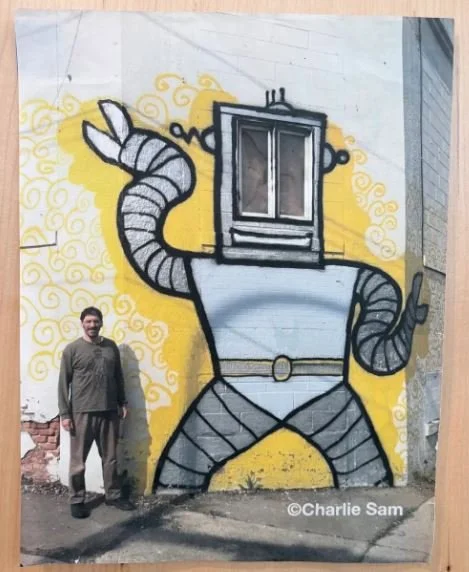
Photo Provided by Charlie Sam
His mother was an artist, and his home contained reproductions of works by artists including Gauguin. Art was not presented to him as something separate from everyday life. It was part of the environment in which he grew up.
But the influence that Sam identifies most strongly is not a traditional fine artist. It is Basil Wolverton, the cartoonist and illustrator whose grotesque, exaggerated and otherworldly drawings became an important influence on generations of artists. Wolverton’s work for Mad Comics, science-fiction imagery and what Sam describes as lowbrow art helped shape his understanding of what graphic art could do. Comic books, he says, were what really got him going in art. That influence is visible in the characters Sam creates today. They can be funny, strange, cheerful, unsettling or all four at once. He is particularly interested in the visual language of comic books, graffiti, tattoos, stickers, and poster design.
Keith Haring is another influence, although Sam’s imagery takes a different direction. Spaceships, babies and figures of death appear in his work, often placed together in combinations that are more playful than threatening.
Death, in particular, appears frequently. Sam has created images of grim reapers carrying alarm clocks or telephones, sometimes accompanied by the traditional scythe. But his interest is not in horror for its own sake. He describes his current treatment of death as more cheerful than the gruesome imagery he produced as a child. The idea is partly rooted in an awareness that death is always present, something that can be represented without turning every image into something grim.
There is also a connection between that sensibility and the cartoon tradition he grew up with. Sam points to the familiar visual language of anvils, safes and pianos falling from the sky. Cartoon violence takes ordinary dangers and exaggerates them until they become absurd. The joke works because the viewer recognizes the possibility of misfortune and then gets to laugh because it is happening to a fictional character instead.
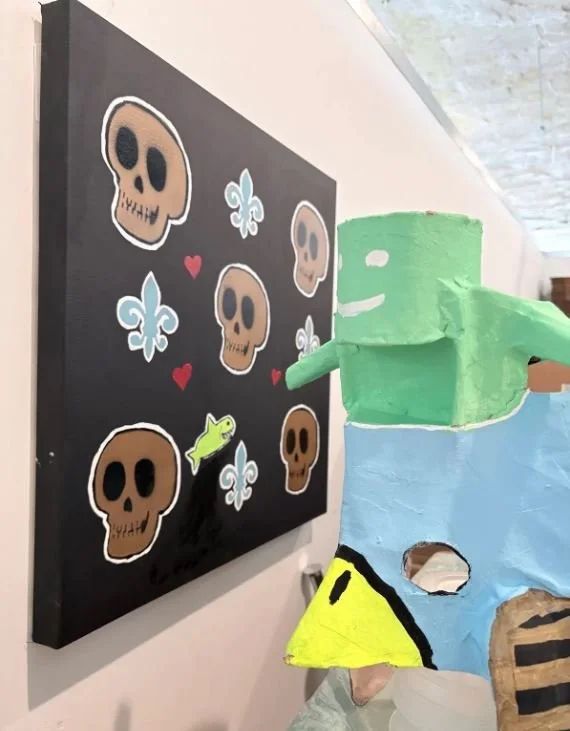
Photo Credit: HonGo David Robertson
Sam’s most recognizable local creation may be the robot that once occupied the front of the Gear Factory. The story began with a small piece of graffiti. Someone had placed a tag on the building, and Gear Factory owner Rick Diestito was unhappy with it. Not because he opposed graffiti, Sam explains, but because he thought the particular tag was unimaginative and unambitious. Sam covered it and, looking at the building’s small windows, saw the beginnings of a robot face.
He painted the face and part of the arms without knowing that Destito was watching. Destito liked what he saw. The public liked it, too. Sam returned with a ladder and completed the figure, which stood roughly 12 or 13 feet high. For a couple of years, the robot became a local landmark. People gave directions using it as a reference point: turn at the building with the robot.
The robot eventually became part of another Gear Factory project. Before the building’s windows were replaced, Destito created a “Before I Die” wall, inspired by a similar project in Louisiana. People were invited to complete the phrase with something they wanted to accomplish before they died. At the Gear Factory, the project covered part of Sam’s robot, and people came to write their wishes on the wall. Sections were periodically washed away to make room for new contributions.
When the building received its new, larger windows, the robot came down. By then it had developed a following of its own. Television news crews covered its removal, and Sam remembers being caught somewhat off guard when a reporter arrived with a camera. He is normally comfortable talking about his work, but the unexpected attention left him temporarily at a loss for words.
Window Eyes, the robot, however, did not disappear. Sam transformed the image into merchandise, including T-shirts, buttons and pint glasses. One of the glasses features the robot’s “window eyes,” with another small robot visible within them. The character became a way of carrying the Gear Factory image into the world beyond the building.
The pint glasses are part of a larger strategy that combines art and commerce without separating the two. Sam noticed that character glasses, once common through companies and restaurants, had largely disappeared. He saw an opportunity and began putting his own characters on glasses. His first pint glass featured the Bugtapus, his flagship design. A hybrid creature combining insect and octopus-like forms. It became what he calls his flagship design. The initial experiment worked well, so he continued, developing a series of character glasses.
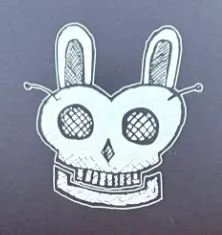
Photo Credit: HonGo David Robertson
The same thinking goes into his stickers. Sam has designed stickers featuring characters such as Bugtapus, Window Eyes and Eyeball Spaceship, but he has also redesigned the material surrounding the sticker. Instead of allowing the backing to become disposable waste, he makes the reverse side resemble a trading card. The paper is heavier, closer to the weight of an index card, and intended to be saved.
His approach to materials is similarly inventive. When Sam needs a break from drawing and painting, he turns to what he calls “food wood,” the discarded wood associated with the food industry. Popsicle sticks, chopsticks, wooden cheese boxes and food packaging can all become raw material. He saves popsicle sticks and sometimes asks people at restaurants to give him their used chopsticks. After cleaning them, he turns them into objects, including small wooden robots.
The reuse of materials connects with a broader interest in making things without unnecessarily buying new materials. Sam also works with papier-mâché and teaches workshops on the subject. He utilities contractors paper and a cooked paste rather than relying simply on newspaper and flour-and-water mixtures. With enough layers and the right materials, he says, papier-mâché can become remarkably strong—strong enough in some applications to rival wood.
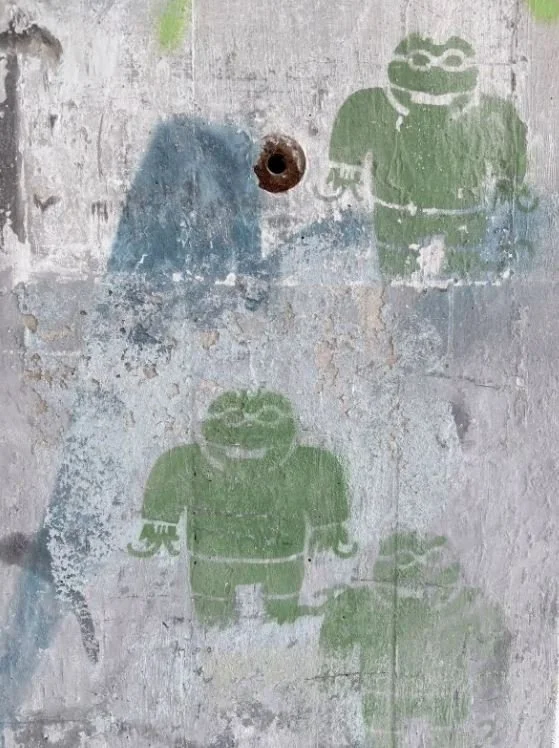
Photo Credit: HonGo David Robertson
Sam’s interests extend into the practical side of being an artist as well. He conducts workshops about copyright and believes artists need a better understanding of the business of art. Copyright, insurance, reproduction rights and general business practices, he says, are areas that are often overlooked in art education. An artist may be highly skilled creatively but still need to understand how to protect and sell that work.
That practical knowledge is important to Sam because his work is designed to move between different forms. A drawing can become a painting. A painting can become a print. A character can appear on a sticker, T-shirt or glass. A mural can become a recognizable symbol of a place. The distinction between fine art and commercial art is less important to him than the opportunity to make something and find an audience for it.
He also believes artists should give people different ways to participate. Not everyone can purchase a $500 painting, but someone may be able to buy a $50 print or a small object. Sam encourages artists to develop different price points and explore different media. It is both a business strategy and a way of making art accessible.
That philosophy is also visible in his long involvement with other artists. For 17 years, Sam helped organize exhibitions as part of the artist collective (R)evolution Studio, presenting major shows at the Gear Factory and other locations. The exhibitions were free for participating artists, with no hanging fee or commission, and included many emerging artists. The events sometimes took place twice a year before the pandemic interrupted the rhythm.
The Gear Factory continues to be an important part of that community. Sam noted that a December 12, 2026 event, titled 12/12, is planned to coincide with the building’s 120th anniversary and the Gear Factory’s 20th anniversary. He also continues to exhibit and encourage other artists to participate.
For Sam, art does not happen in isolation. It exists within a network of artists, audiences, buildings, neighborhoods and shared interests. Syracuse’s art community provides the setting, but his own curiosity keeps expanding the boundaries.
That curiosity reaches into chess, another subject that came up during the interview. Sam plays regularly and admits that he is not a particularly strong player yet. He likes strategy and the process of learning. The same attitude applies to his art. He does not describe himself as having arrived at a final destination. He is still learning, still experimenting and still making things.
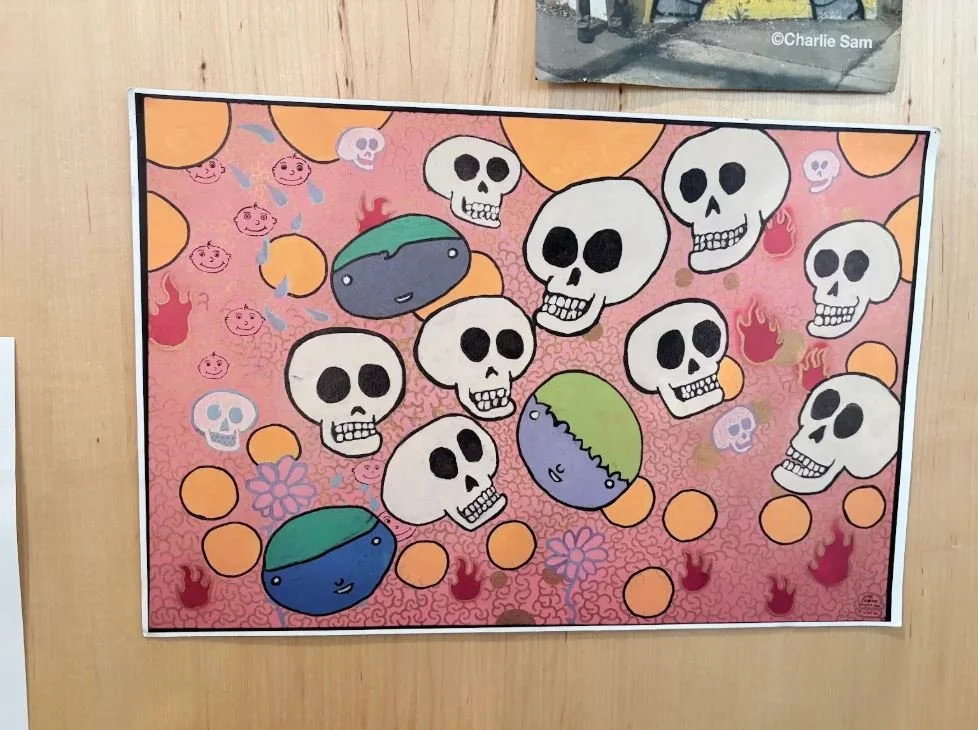
Photo Credit: HonGo David Robertson
His upcoming public appearances include the Westcott Nation Fest on September 27, where he plans to set up a tent at Westcott Street and Harvard Place, outside Mom’s Diner. He expects to bring T-shirts and other merchandise rather than a large selection of paintings. His paintings are also displayed at Forum Barbershop on Fayette St. in Armory Square, Syracuse, near Funk ’n Waffles.
By the end of the morning at the Gear Factory, the interview has become less like a conventional discussion about painting and more like a tour through the interconnected pieces of Sam’s creative life. Characters become merchandise. Waste becomes sculpture. Stickers become trading cards. A mural becomes a landmark and later a glass. Comic books lead to graphic design. Graphic design leads to copyright workshops. Art leads to organizing exhibitions and helping other artists.
There is a practical consistency underneath all of it. Sam makes things, learns from making them, finds ways to share them and then starts making something else. His description of his work remains deliberately simple: he makes “cute, cool, and creepy designs for kids and odd people.” It is an unusually accurate description of an artist who has spent decades moving comfortably between paintings, murals, comic-inspired characters, recycled materials, merchandise and community projects.
At the Gear Factory, surrounded by evidence of all those interests, Charlie Sam does not appear particularly concerned with deciding what kind of artist he is. He is more interested in what he can make next.