
Kevin Abbott: Building a Life from Found Things
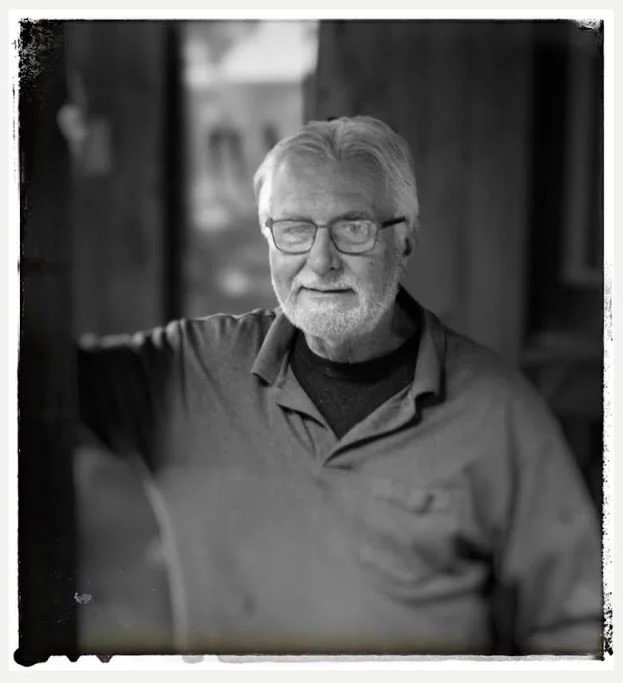
Photo Credit: HonGo David Robertson
On a quiet six-acre property tucked into the woods of Bernhards Bay, New York, Kevin Abbott has spent more than three decades creating a place that reflects the same philosophy found throughout his artwork. Nothing here feels hurried. Stone walls wind through the property. A small cabin rests among towering pines. A workshop stands nearby, powered largely by the sun, surrounded by piles of weathered steel waiting for their next life as sculpture. Each building, every path, every garden bed and wall has been constructed a little at a time, paid for as circumstances allowed. It is less a studio than an evolving landscape, shaped by patience rather than deadlines.
Abbott spends roughly four months each summer here before returning to Florida, where he now lives. The property had originally been intended as an off-grid homestead, a permanent home where he and his wife Debe would build a self-sufficient life. Life, however, had other plans. Aging parents, family responsibilities, an inherited home in Florida, and years of caregiving gradually shifted the course of his life. Instead of becoming a permanent residence, the Bernhards Bay retreat became something equally meaningful, a seasonal refuge where he could continue making art surrounded by the woods he loves.
That willingness to adapt, rather than resist change, seems to define both Abbott's life and his work. Born and raised in southern Vermont, Abbott grew up in a family whose roots stretched back generations before Vermont achieved statehood. Surrounded by mountains, forests and small towns, he developed an early appreciation for craftsmanship. His maternal grandfather was an accomplished woodworker; fly fisherman and woodcarver whose handmade bird still occupies a place of honor in Abbott's studio. It serves as quiet reminder that creating with one's hands can become a way of understanding the world.
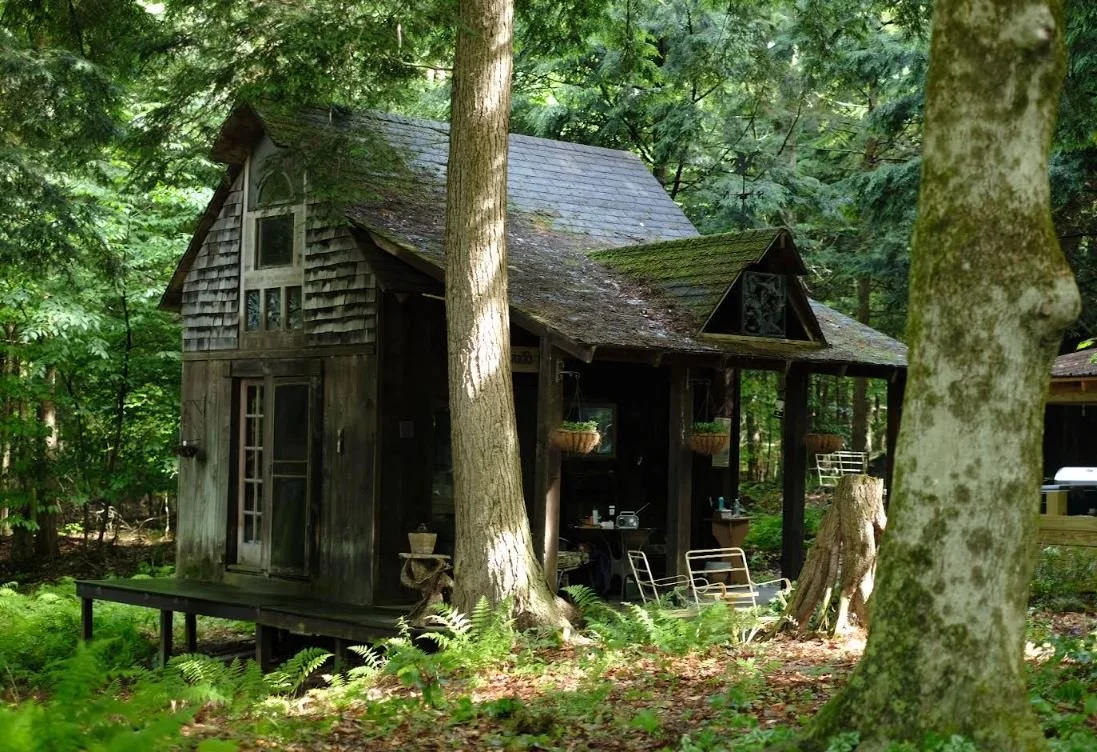
Photo Credit: HonGo David Robertson
Art fascinated him from an early age, but painting seemed out of reach. "I thought because I couldn't draw, I couldn't paint," he recalled. Photography became the doorway instead. After graduating from high school in Springfield, Vermont, in 1978, Abbott enrolled in a photography school in Massachusetts. Like many young photographers, he imagined a future filled with magazine assignments and documentary work. His first professional job, however, was photographing weddings and senior portraits for a small studio back home. He quickly discovered that commercial portrait work was not the future he envisioned.
Searching for direction, Abbott briefly enrolled at the University of Massachusetts as an art major before deciding he needed greater discipline. At nineteen, he enlisted in the United States Army with the intention of becoming a combat photojournalist. The military did indeed change the course of his life, although not in the way he expected. Rather than sending him into the field with a camera, the Army assigned him to an aerial reconnaissance unit at Fort Bragg, North Carolina, where he processed large rolls of aerial reconnaissance film inside portable darkrooms. At the time, Abbott found the assignment disappointing. Looking back, he recognizes it as an invaluable education in photographic precision and technical discipline during a period when military intelligence was transitioning from traditional film to satellite imagery. The assignment also introduced him to the woman who would become his wife. Debe served as an imagery analyst, interpreting the reconnaissance photographs Abbott developed. Marriage and the arrival of their first child soon followed, altering his military career once again.
The Cold War was still underway, and Abbott qualified for the Army's Russian language program. He spent a year studying Russian at the Defense Language Institute in Monterey, California, one of the nation's premier language schools. Although he excelled initially, the increasingly demanding coursework eventually convinced him that becoming a linguist was not his calling.
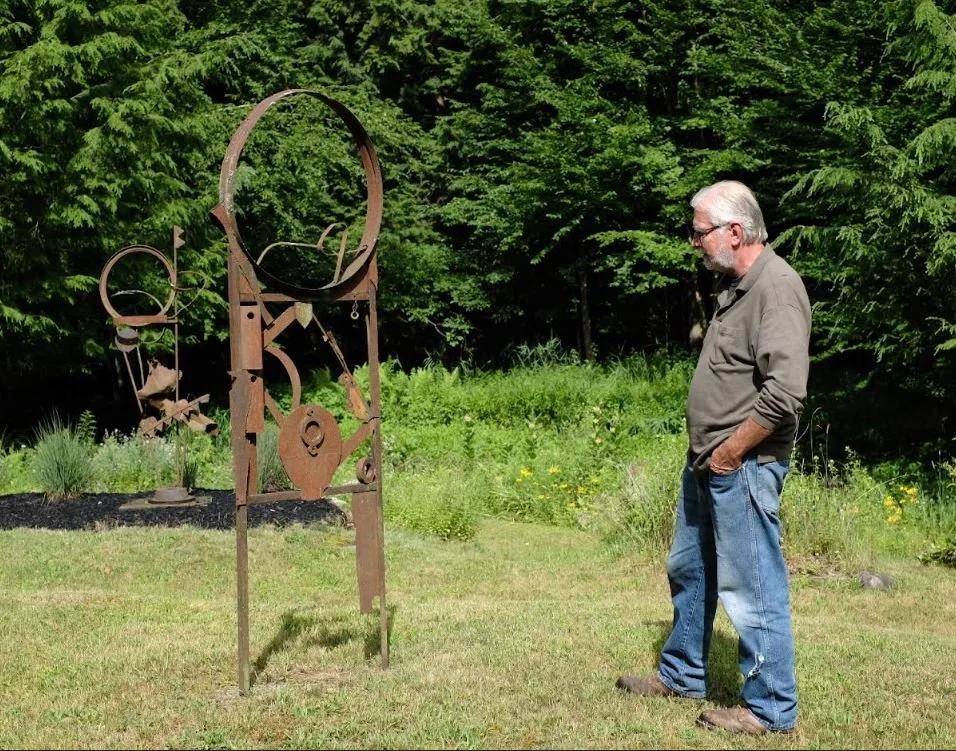
Photo Credit: HonGo David Robertson
Fortunately, another opportunity emerged. Transferred to Fort Ord, California, Abbott finally became the Army photojournalist he had hoped to be years earlier. Working for the post newspaper, he documented military life while also producing feature stories encouraging soldiers to explore Northern California during their free time. Assignments took him to Yosemite National Park, Point Lobos, Bodie Ghost Town, the opening of the Monterey Bay Aquarium, Alaska and Idaho.
Photography became more than simply making pictures. It required interviewing people, researching stories, writing captions and eventually producing entire articles. Those early attempts returned from editors covered in corrections, but they became an education in storytelling every bit as valuable as learning to expose film correctly.
By the time Abbott completed his military service, photography had become second nature. Painting, however, was waiting patiently in the background. The transition happened gradually. Abbott began incorporating his photographs into mixed-media collages, combining prints with encaustic wax painting after fellow artist George Welch introduced him to the medium. Welch, an influential Syracuse artist and veteran, became both mentor and friend.
Those experiments evolved into a distinctive body of collage work that combined Abbott's own photography with antique tintypes and found photographs discovered in antique shops. During the mid-1990s, few artists were exploring that territory. The work attracted gallery attention throughout Central New York and sold successfully. As artistic trends shifted, Abbott quietly moved on.
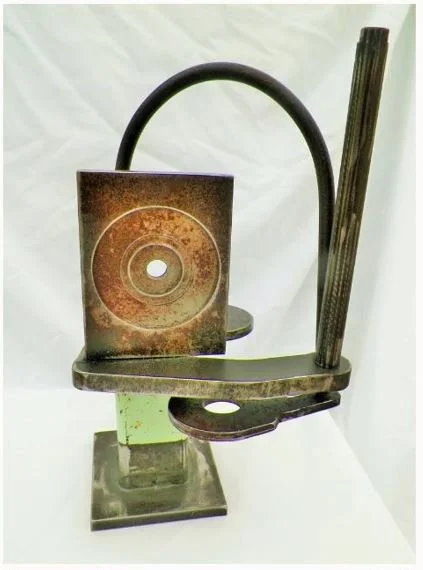
Photo Provided by Kevin Abbott. “Composition in Steel II, 2018”
Abbott's sculpture embodies that philosophy most clearly. Scrap steel, discarded machinery, brake rotors, washers, rods and forgotten industrial components become balanced compositions that feel simultaneously mechanical and organic. Each object carries its own history before entering the studio, and Abbott prefers listening to those histories rather than imposing rigid plans.
"I work intuitively," he explained. Sketches may begin an idea, but they rarely determine the finished piece. As he welds and assembles found objects, the materials begin suggesting their own direction.
"The pieces tell me where they want to go," he said.
For Abbott, the goal is not beauty for its own sake.
"I'm not trying to make pretty things," he said. "I appreciate beautiful things, nice things, but that's not what I'm looking to make. If something beautiful happens, it's a happy accident."
Instead, he hopes his sculptures create a moment of curiosity. He wants viewers to pause, circle the work, and ask questions.
"What is this? What does it mean? What was he thinking?"
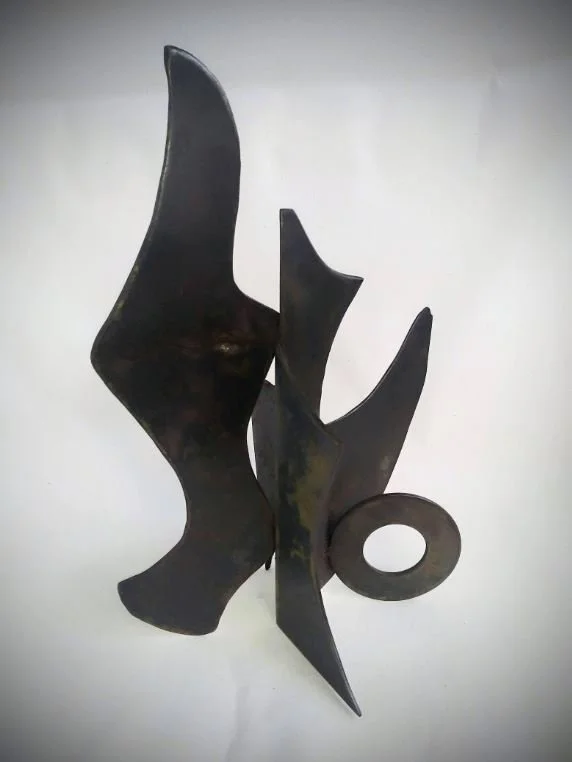
Photo Provided by Kevin Abbott. "Homage" Part of the permanent collection of the David Hayes Art Foundation.
Those questions are more important to him than providing easy answers. Abbott isn't interested in creating art that relies on shock value or controversy simply to attract attention. He prefers work that quietly invites engagement—pieces that reveal themselves slowly and reward careful observation. His sculptures ask the viewer to spend time with them rather than simply admire them from a distance.
That philosophy explains why so many of his sculptures resist literal interpretation. A brake rotor becomes the base of an elegant composition. A bent steel rod suggests movement. A weathered washer becomes an eye or a point of balance. Industrial remnants shed their original purpose without losing their history, becoming objects that feel strangely familiar while remaining impossible to fully define.
Found objects arrive from many sources. Friends save unusual pieces for him. His son frequently discovers interesting metal during travels. Years ago, Abbott enjoyed access to the scrap bins of a large fabrication company, where mild steel offcuts became raw material for future sculptures. Even now, piles of rusting steel surround his workshop, each waiting for the right moment. Many of his sculptures remain unpainted, protected only with clear coatings that allow the natural rust patina to continue evolving outdoors. The changing surface becomes part of the artwork rather than something to resist.
Among Abbott's strongest artistic influences are pioneering American sculptor David Smith and Smith's student David Hayes, whom Abbott came to know personally. Hayes became an important mentor, introducing Abbott to large-scale steel sculpture and encouraging his own exploration of welded abstraction. That lineage remains visible throughout Abbott's work, although his sculptures possess a quieter intimacy than monumental public commissions. Even the larger pieces seem less interested in dominating space than in conversing with it.
His paintings follow a similar instinct. Rather than depicting literal landscapes, many become meditations on plant forms, movement and growth. Layers emerge intuitively until the composition feels complete. If it never reaches that point, Abbott simply paints over it and begins again.
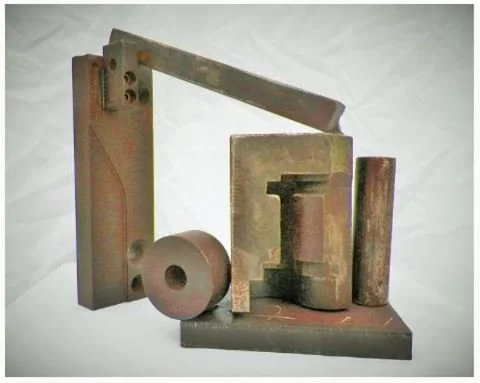
Photo Provided by Kevin Abbott. “Composition in Steel III, 2018”
That practical outlook extends beyond the studio. Abbott does not romanticize the business side of art. He readily admits that marketing remains necessary even if it is not his favorite part of being an artist. "I don't do art to sell it," he said. "But I like to sell it. It provides me the income to continue."
During the COVID-19 pandemic, when galleries closed across the country, Abbott adapted by aggressively marketing his work online. Unexpectedly, collectors from across the United States began purchasing paintings and sculptures, expanding his audience far beyond regional gallery visitors. Like many artists, he discovered that periods of disruption sometimes create entirely new opportunities.
Today his work is represented by Four Elements Studio in Utica, where new paintings and sculptures often arrive directly from his Bernhards Bay workshop before continuing on to collectors.
Yet success has not changed Abbott's working habits. His summer retreat still operates much as it always has. Rainwater is collected from the roof and filtered for bathing. Solar panels power lights, tools and a small water pump that provides an outdoor shower. The buildings remain intentionally simple. Improvements happen slowly, one project at a time. Looking around the property, Abbott points to unfinished walls, future additions and projects waiting for another summer. Nothing feels neglected. Everything feels alive.
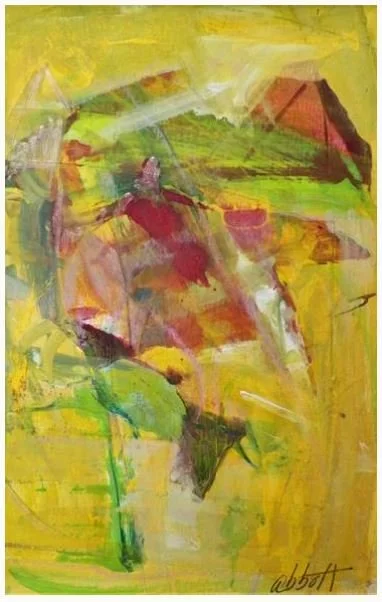
Photo Provided by Kevin Abbott. "Untitled" (16”x21”)
Even setbacks become part of the story. Several years ago thieves broke into the property, stealing thousands of dollars' worth of welding equipment, tools and family heirlooms. Rather than abandoning the place, Abbott rebuilt, boarded the buildings more securely and continued making art.
Abbott's sculptures are not merely assembled from found objects. They are assembled from experiences accumulated over decades, photography, military service, family, mentors, loss, craftsmanship and countless hours spent observing how weather transforms steel and the land that surrounds his summer home refuge.
Nothing is wasted. Everything has its purpose. A rusted washer becomes an eye. A bent rod becomes movement. A discarded brake drum becomes the foundation for balance and grace. The materials may be industrial, but the finished works feel deeply human.
Perhaps that is why Abbott's sculptures seem so at home in the woods surrounding his summer retreat. Like the property itself, they were built patiently, piece by piece, guided less by certainty than by curiosity. Over time, both the landscape and the artwork have grown together, each revealing the quiet satisfaction of a life devoted to making something meaningful from whatever the world leaves behind.
For more information you can contact Kevin at: "kabbott765@gmail.com"
View his work at Saatchi Art: https://www.saatchiart.com/kvabbott