
Steve Nyland: Art of Wooden Boxes and Accretion
I met artist Steve Nyland at his home studio on a warm June morning to talk about his current work, his creative process, and the path that brought him back to making art after several difficult years. The conversation moved easily between painting, family, space exploration, education, and the challenges of rebuilding a creative life.
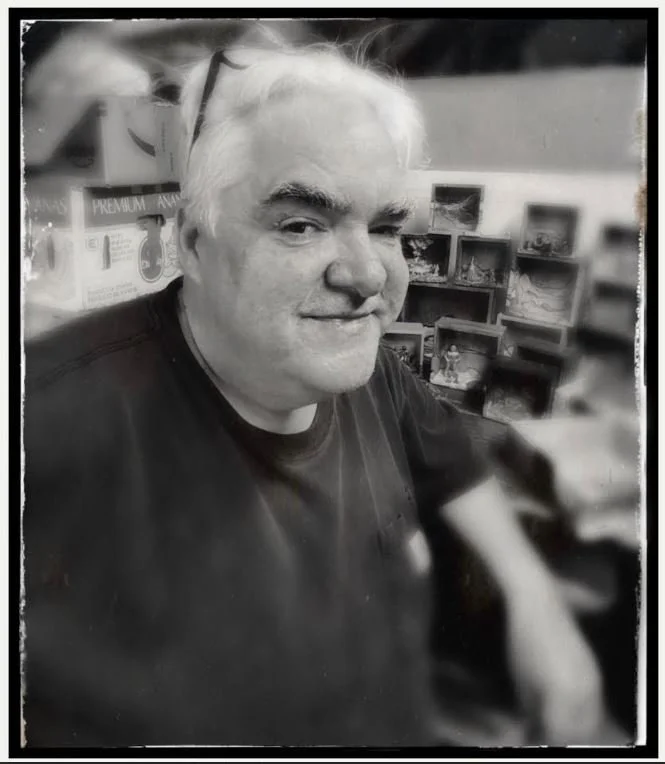
Photo Credit: Hongo David Robertson
Nyland's studio occupies the lower level of his family home. The space is filled with small wooden boxes in various stages of completion. At first glance they appear to be paintings, but Nyland describes them differently.
"I've come to call the actual way that I'm creating the paintings accretion," he told me.
Nyland state that “the term comes from planetary formation, where matter gradually accumulates through countless impacts and layers”. It is an appropriate description for his work. Rather than creating a painting in a single session, Nyland builds his surface slowly over time. Layer after layer of acrylic mediums, gels, crackle paste, metallic pigments, and interference paints are applied, allowed to dry, and then covered again. Many of the boxes require weeks of work before they are finished. "I do a pass," he explained. "Each pass results in more depth and more complexity."
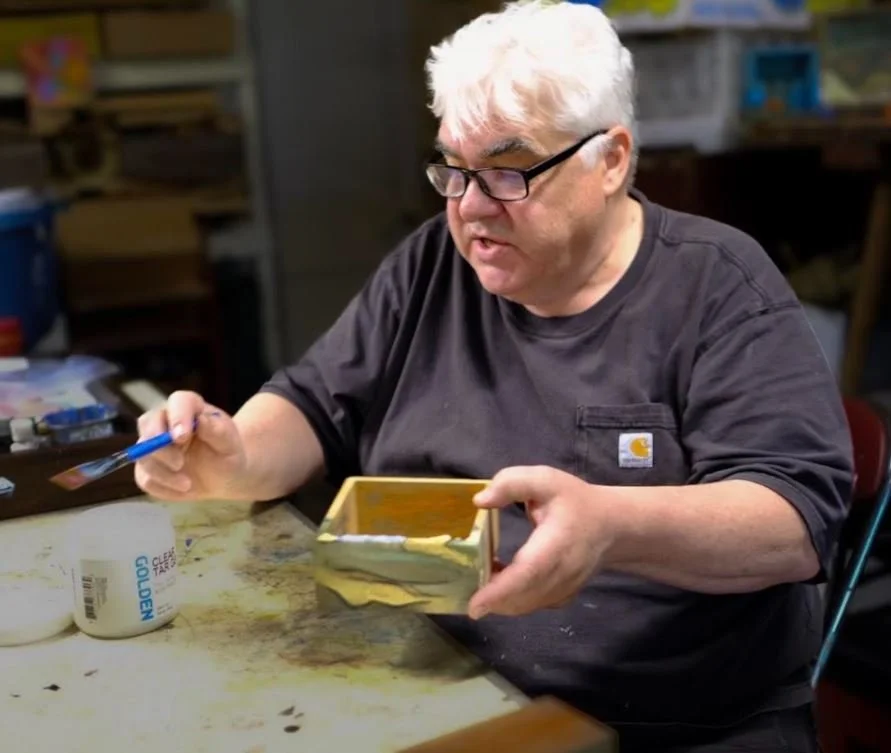
Photo Credit: Hongo David Robertson
The small wooden boxes themselves are commercially manufactured craft boxes purchased online. Nyland began using them several years ago as a way to create miniature environments connected to his collection of vintage space figures. Over time, however, the boxes became more important than the figures.
Something changed in his artistic goals during the past year. "I want to be known for making beautiful paintings," he said. "Before, people would say the work was clever or interesting or funny, but I never heard that it was beautiful."
That desire has influenced both his materials and his approach. Rather than focusing on drawing or traditional representation, Nyland has increasingly allowed the physical properties of acrylic mediums to shape the work. Much of that knowledge came from years of attending open studio sessions at the Golden Foundation in New Berlin, New York. There he observed artists experimenting with materials and learned how various acrylic products interacted with one another.
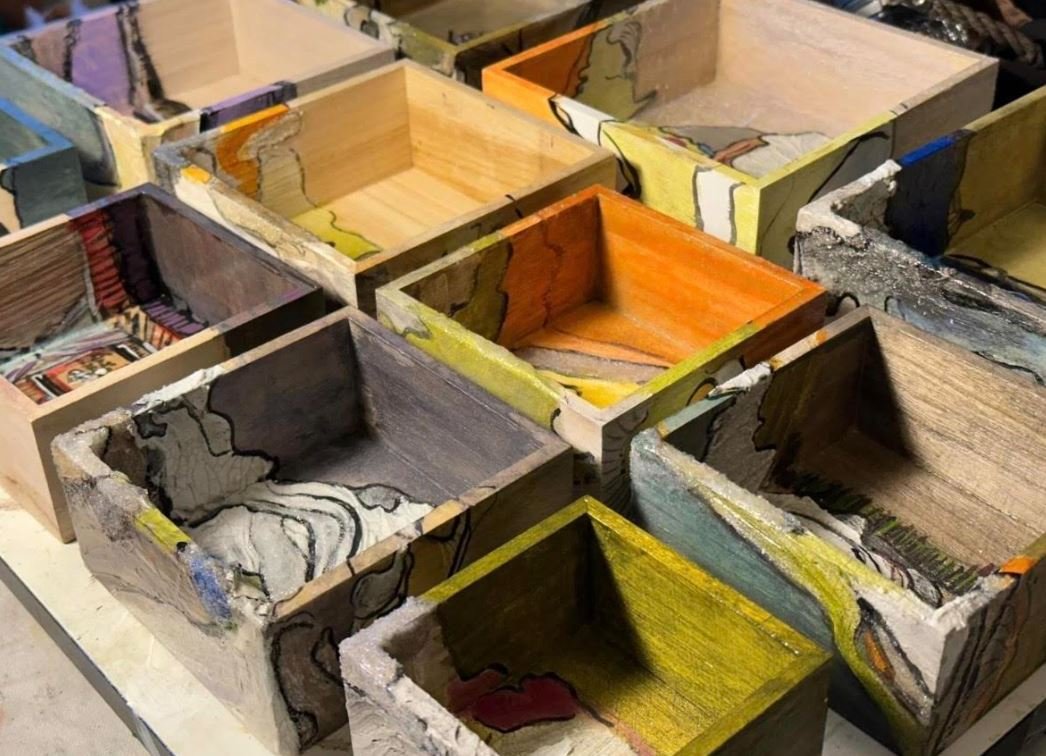
Photo Credit: Hongo David Robertson
One of his most significant discoveries involved combining Golden Clear Tar Gel with Golden Glass Bead Gel and interference paints to create optical effects that suggest depth, movement, water, and terrain. He readily admits that many of the techniques developed through experimentation and mistakes rather than formal instruction. "I've learned how to combine them in a way that isn't correct," he said with a laugh. "But it results in effects I couldn't have planned." The resulting surfaces often resemble ponds, streams, marshes, and other natural environments. Although many viewers describe the work as abstract, Nyland disagrees.
"They're all landscapes," he said. "They're all based on observation." Water, mud, and natural textures appear repeatedly throughout the work. During our conversation he showed me several pieces inspired by drainage ditches, puddles, frog ponds, and local waterways. One work was based on a memory of visiting a property in Fayetteville where a small pond had caught his attention years earlier.
Nyland's fascination with constructed landscapes may stem from growing up across the street from a golf course. He described golf courses as beautiful works of art created through human attempts to control nature. That tension between natural processes and human intervention appears throughout his work.
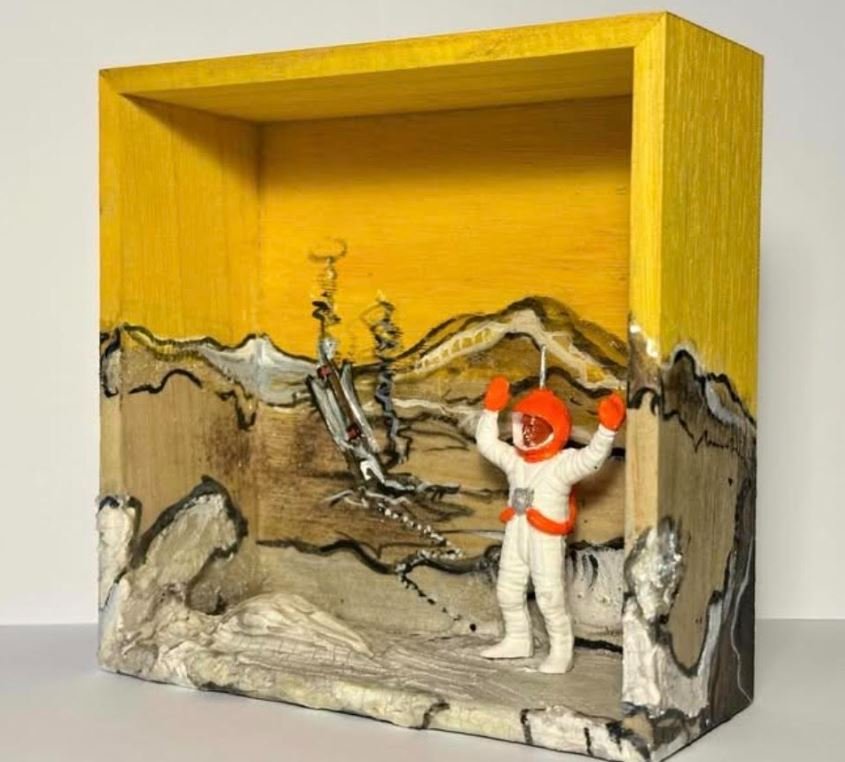
Photo Credit: Steve Nyland
As he demonstrated his techniques, moving from piece to piece in what resembled an assembly line, it became clear that patience is one of the defining features of his practice. Layers dry overnight. Some materials require days before they fully cure. A finished piece may contain seven or more distinct applications of various mediums.
Many of the works are designed to be handled rather than simply viewed from a distance. "They're meant to be held," he said. "They're meant to be picked up and looked at." That philosophy presents challenges when exhibiting the work. Several pieces contain imagery on every surface, including the bottoms. Traditional wall display methods do not always allow viewers to experience the objects completely.
A forthcoming exhibition at the Kirkland Art Center will provide new opportunities to present the work publicly. Nyland also currently has work displayed at Art Haus in downtown Syracuse.
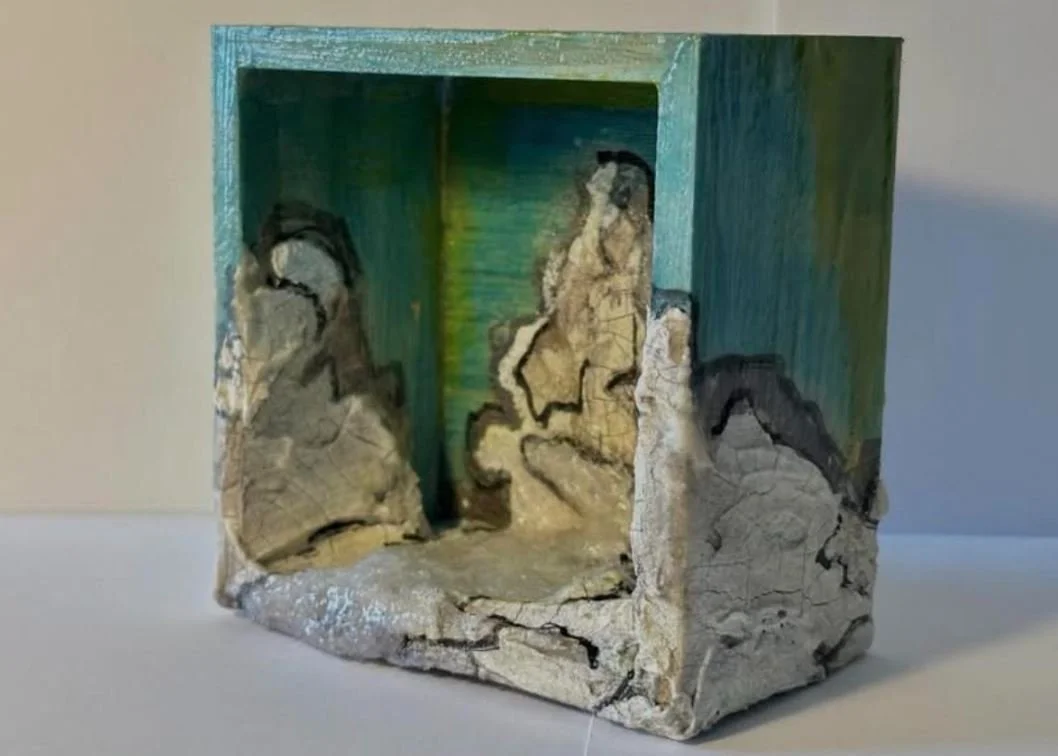
Photo Credit: Steve Nyland
Beyond painting, Nyland maintains a long-standing interest in video game level design. For decades he has created virtual environments for games he enjoys playing. Although very different from gallery art, he sees strong connections between the two pursuits. "When I'm making these pieces, I'm really surfacing them," he said. "It's similar to texturing environments in a game."
His interest in imagined worlds also connects directly to his lifelong fascination with the space program. Born in 1967, Nyland grew up during the Apollo era. He vividly remembers being brought downstairs by his father to watch historic space missions on television. Vintage space figures remain an important part of his collection and occasionally influence his artwork. The original concept behind many of the box pieces involved incorporating astronaut figures into miniature environments. Although the figures gradually became less central to the finished works, the influence remains visible.
Nyland studied art at Syracuse University, where he earned a Bachelor of Fine Arts degree. He later received his MFA from SUNY Albany and completed postgraduate work in New York City. His education exposed him to a wide range of disciplines including sculpture, industrial design, media studies, aesthetics, and art history. Along the way he worked with several notable instructors and artists who helped shape his thinking.
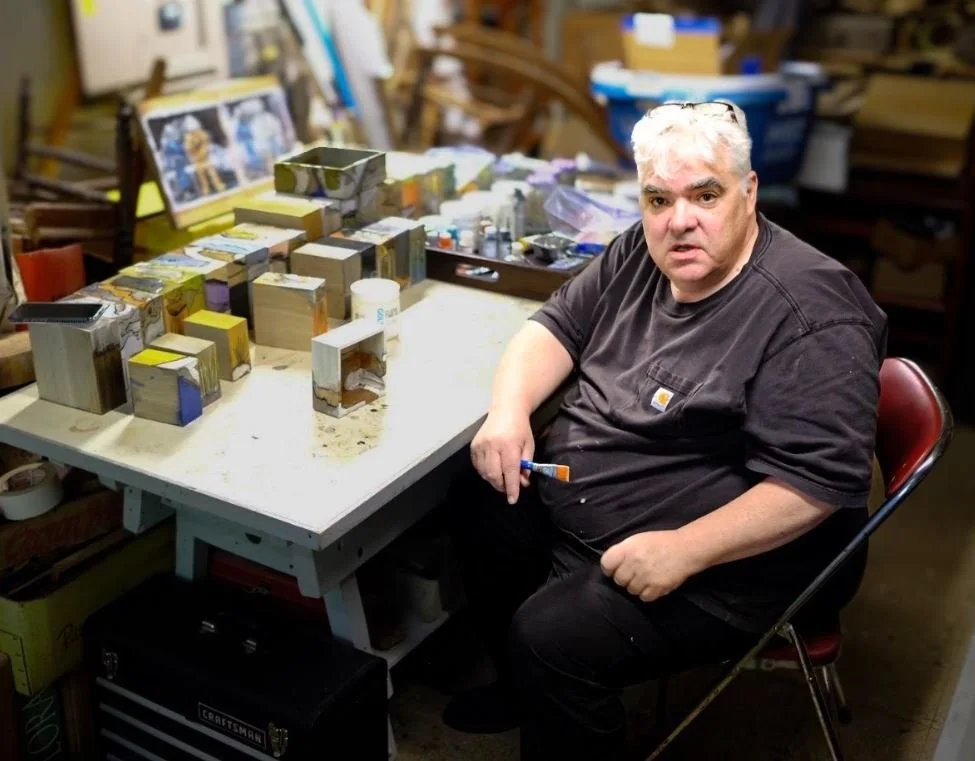
Photo Credit: Hongo David Robertson
Despite that formal training, Nyland's artistic journey has not been uninterrupted. Like many artists, he experienced periods when art production slowed dramatically while other interests took priority. Photography, video editing, computer graphics, and game design all occupied significant portions of his time.
The most recent interruption was more personal. During the COVID-19 pandemic, Nyland moved back into the family home to help care for his parents. Following the loss of his mother, he remained with his father, Ralph. Throughout our conversation it became apparent how deeply that loss affected him. "We've all lost someone we loved," he said. "And that changes you." For a period, making art became difficult. Public engagement became difficult as well. "I couldn't have done this interview a year ago," he told me. "I was a mess."
Several things helped him find his way back. One was attending his high school reunion. Another was returning to golf and finally playing a full round on the course across the street from his childhood home. Most importantly, however, was finding a renewed sense of purpose. "What happened when Mom died was that things stopped being fun," he said. "Getting that sense of fun back made a huge difference."
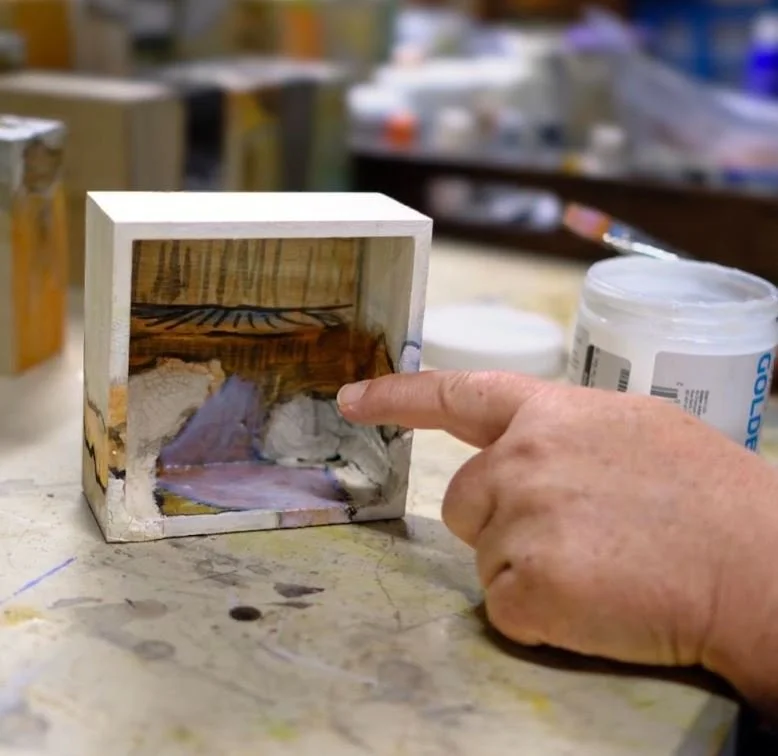
Photo Credit: Hongo David Robertson
The home itself has become part of that healing process. Nyland spent much of the past year restoring gardens that had once belonged to his mother. Areas that had been overgrown for years have been cleared and revived. Each evening he lights a candle outdoors and spends a few quiet moments reflecting. "I had to take care of this for her," he said. The restoration of the property coincided with his return to active participation in the local arts community. Cleaning the gardens and reclaiming the space helped create the foundation for everything that followed.
As our conversation continued, Nyland spoke enthusiastically about future plans. He hopes to continue refining his current body of work while also returning to figure drawing. He recently committed to attending regular figure drawing sessions and has begun exploring more traditional landscape imagery. Several new works draw inspiration from local waterfalls and Central New York scenery. Others continue his ongoing exploration of water, terrain, and layered surfaces.
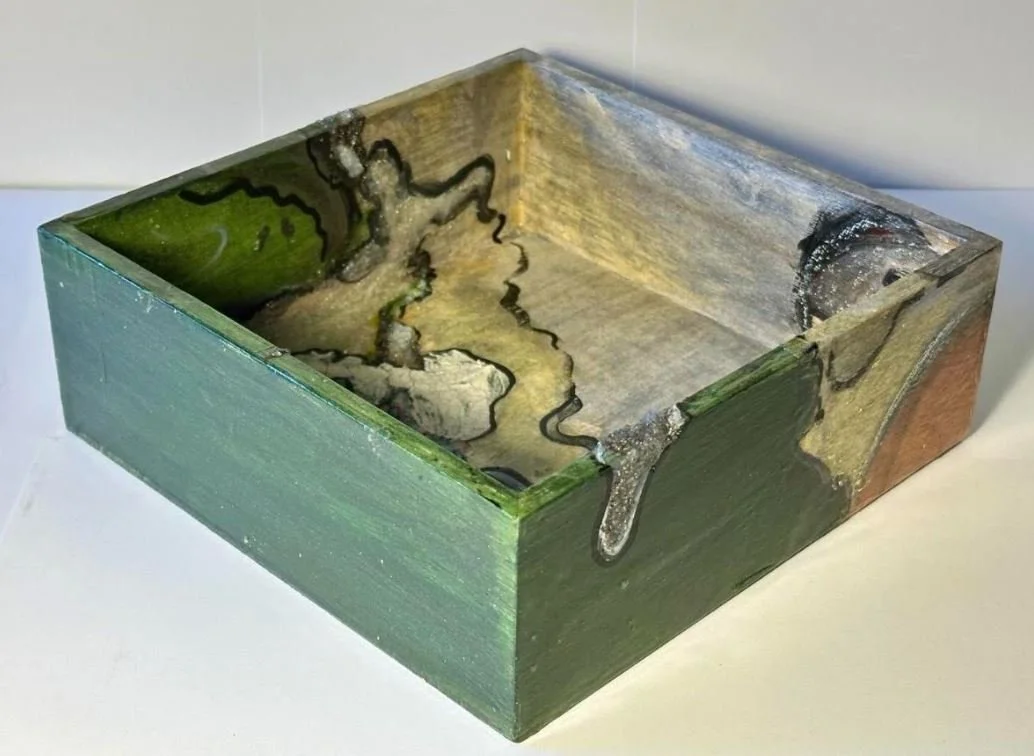
Photo Credit: Steve Nyland
Throughout the interview, one theme remained consistent. Whether discussing acrylic gels, video game environments, golf, space exploration, or family memories, Nyland repeatedly returned to the idea of possibility. His work is not driven by a predetermined outcome. Instead, it develops gradually through observation, experimentation, and patience. Layers accumulate. Surfaces evolve. Landscapes emerge.
Standing in his studio surrounded by dozens of boxes in various stages of completion, it was easy to see that process at work. Each piece represented not only a physical accumulation of materials but also a rebuilding of creative confidence after loss. For Steve Nyland, the work continues one layer at a time.