
Penny Santy: Brushstrokes of Rebellion and Experimentation
Behind the industrial walls of Santy Glass on Burnet Avenue in Syracuse, New York, tucked away in a working studio alive with paint cans, jars, charcoal dust, and towering canvases, artist Penny Santy speaks about painting the same way some people speak about meditation. Her words move easily between memory and process, between artistic rebellion and quiet revelation. The studio itself mirrors that energy, “messy” she states, however my first impression is messy, yes, but in an honest way, messy you’d want to see in a working artist. Layered with evidence of work, experimentation, risk, and devotion. Nothing about the space feels staged. Every brush, rag, and paint-smeared surface suggests work that is deeply lived-in.
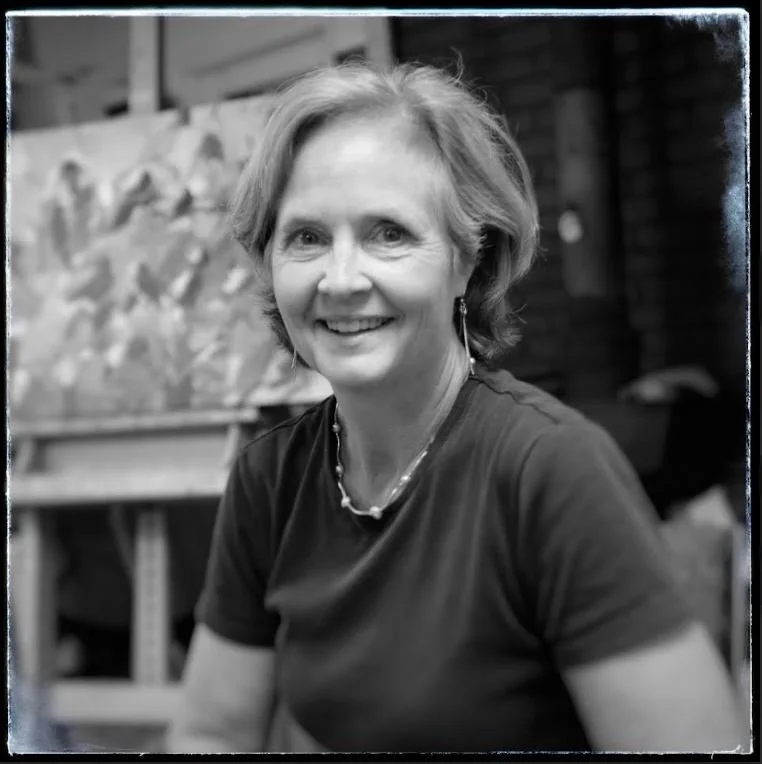
Photo Credit: Hongo David Robertson
Santy grew up in Fayetteville, New York, in a family where art already had roots. Her older brother, Douglas Martenson, became a successful painter and now teaches at the Pennsylvania Academy of Fine Arts in Philadelphia. Her sister attended Syracuse University for sculpture. Creativity surrounded her early on, though encouragement did not always follow. Santy recalls her father belonging to a generation that believed women should pursue practical careers rather than artistic ones. The resistance only strengthened her resolve. “I was always rebellious,” she says with a laugh, admitting that rebellion may be one of the defining traits shared by many artists.
As a child, she filled paint-by-number sets with her own instincts and alterations, already refusing to stay inside prescribed boundaries. She remembers spending endless hours drawing and painting throughout school, gravitating naturally toward art classes while other subjects faded into the background. Even then, there was less interest in perfection than in exploration. The materials themselves fascinated her, the way colors interacted, the way marks accumulated meaning.
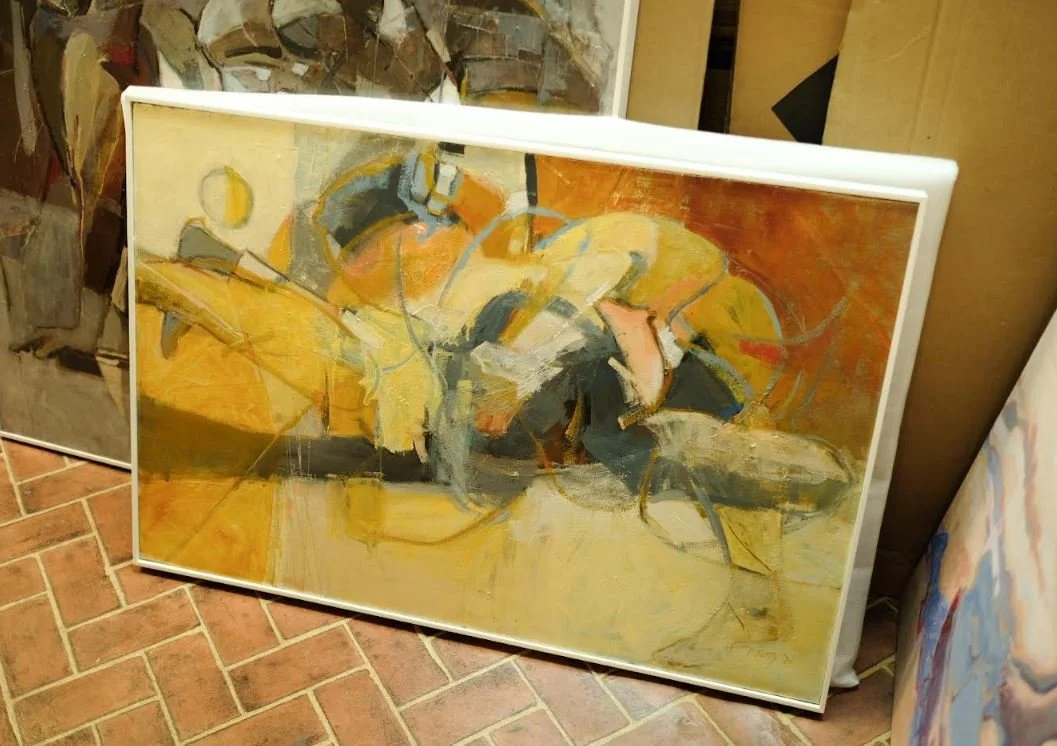
Photo Credit: Hongo David Robertson — Painting is titled “Inner Space”, 36” x 24”
Her artistic awakening came later during a visit to the Philadelphia Museum of Art, where she encountered Anselm Kiefer’s monumental work Nigredo. The painting overwhelmed her. Massive, textured, layered with straw, tar, and the scars of history, it carried the emotional weight of postwar devastation. Santy remembers standing before it and suddenly understanding the true power of painting. Art did not have to be decorative or polite. It could confront, disturb, and move people at their core. That moment altered her understanding of what painting could do.
That realization followed her to Syracuse University, where she initially enrolled in illustration, hoping practicality might provide stability. It did not last long. Being told what to draw quickly became unbearable. Santy describes bringing oversized charcoal works into critique sessions only to hear professors question how such work could ever function as illustration. Rather than discouraging her, those moments clarified something essential. She did not want to create images that merely served a purpose. She wanted to paint freely. Eventually she switched to fine arts and discovered oil painting in earnest.
At Syracuse University, professors such as Sharon Gold and Steven Zaima became important influences. Zaima’s abstract work and Gold’s emphasis on painterly expression helped deepen Santy’s understanding of material and process. She also learned practical lessons there, particularly regarding the toxicity of traditional oil materials. To this day, she paints carefully, often using walnut oil rather than harsher solvents, and wears gloves while working. The physical realities of painting matter to her. Art may be spiritual, but it also lives in the consciousness of the body.
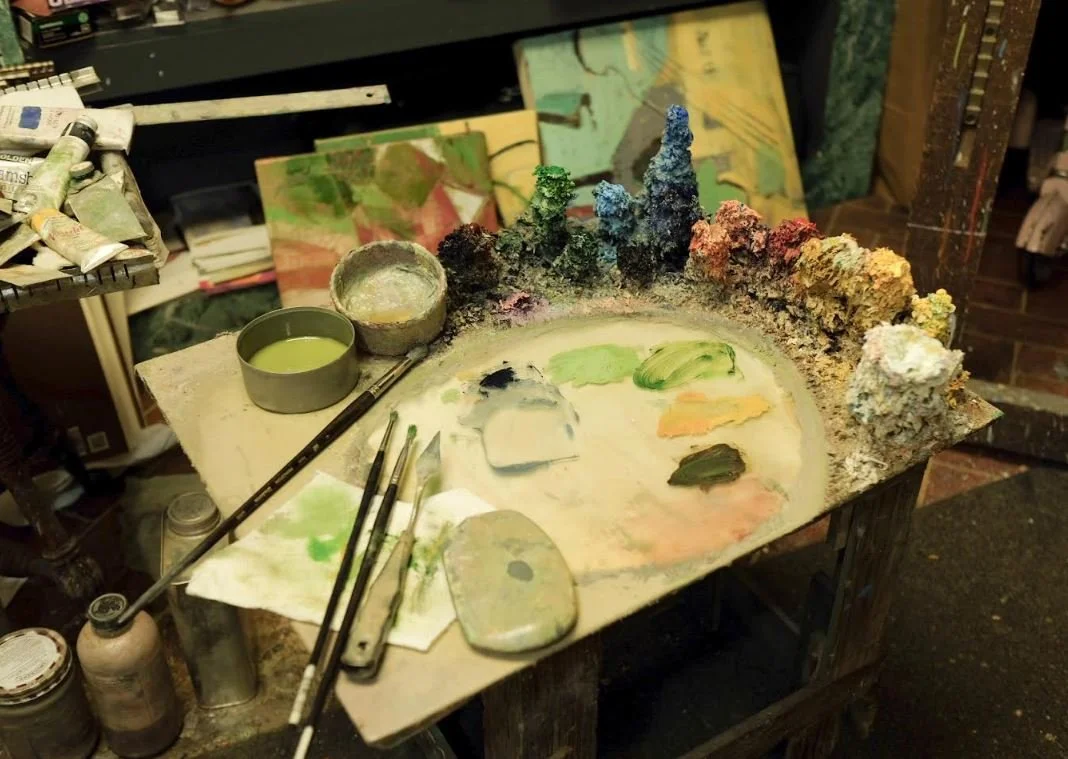
Photo Credit: Hongo David Robertson
Throughout the conversation, Santy repeatedly returns to the idea of emotional connection. Technical skill matters, but only insofar as it serves feeling. She speaks passionately about artists whose work carries emotional weight: Richard Diebenkorn, David Park, Joan Mitchell, Helen Frankenthaler, Jennifer Packer. She admires painters who leave evidence of struggle and gesture visible on the canvas. Paintings should breathe. They should retain the energy of their first marks rather than becoming overly polished or self-conscious.
Looking around her studio, that philosophy becomes visible everywhere. Many of her canvases balance abstraction with traces of the figure. Color fields emerge and dissolve. Lines scratch through layered paint. Areas of careful structure collide with loose, instinctive gestures. Santy describes painting as a conversation rather than a plan. The first marks on a canvas are often the most important because they contain raw immediacy. The challenge becomes preserving that freshness through the entire process. If a painting becomes too controlled, she deliberately disrupts it, slashing across surfaces with brushes or scraping away passages to rediscover spontaneity.
Her admiration for large-scale painting also reveals itself in the studio. Santy explains that big paintings allow both artist and viewer to physically enter the work. A large canvas changes the relationship between body and image. The painter moves differently, using the whole arm rather than the wrist. The viewer no longer simply observes the painting but experiences it through deeply felt emotions. She references Diebenkorn’s Ocean Park series and again returns to Kiefer, whose massive works overwhelm through sheer physical presence. Paintings at that scale become environments rather than objects.
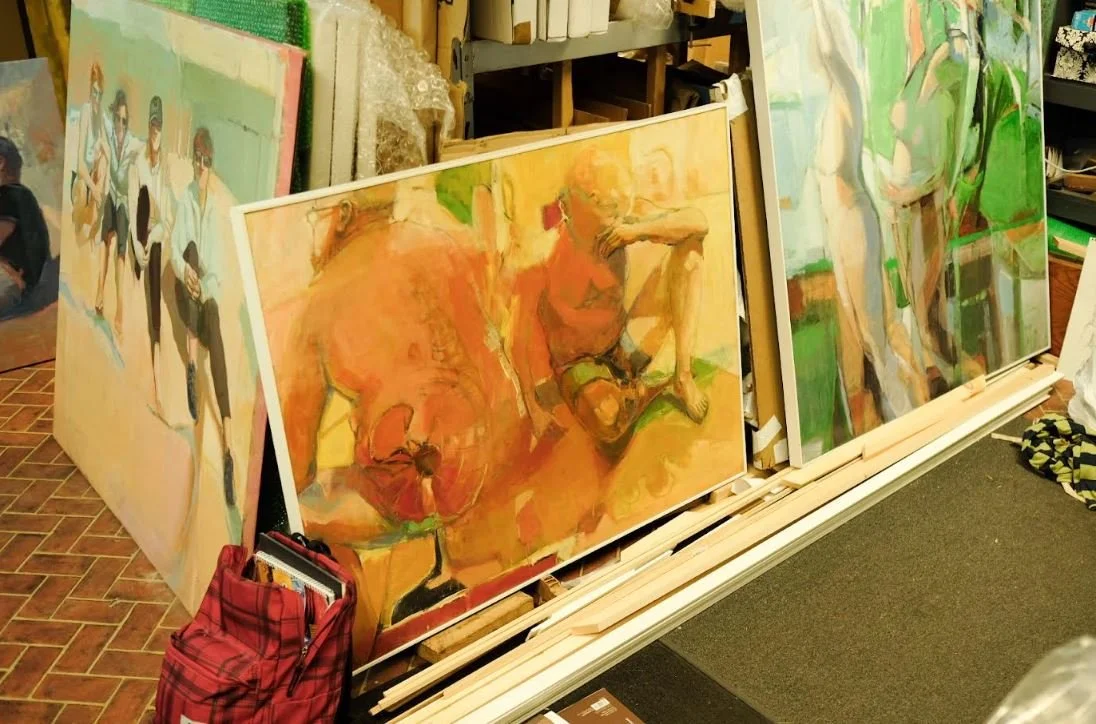
Photo Credit: Hongo David Robertson
Despite her deep commitment to painting, Santy speaks candidly about the realities artists face trying to survive financially. After college, she traveled alone to New York City carrying a handmade portfolio, determined to find illustration work. Armed with maps and persistence in the days before GPS, she visited agencies directly, calling from payphones outside their offices and convincing them to view her work on the spot. Though she never landed a job from those visits, the experience taught her something invaluable: personal connection matters more than almost anything else. People respond to sincerity and presence. That lesson continues to shape how she approaches galleries, collectors, and artistic communities today.
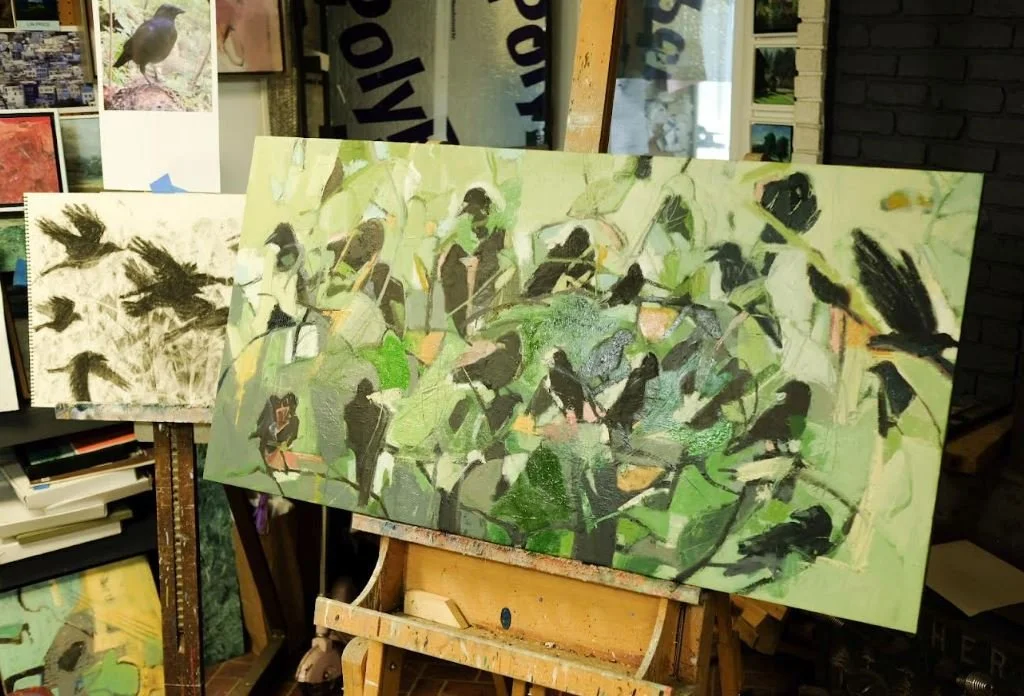
Photo Credit: Hongo David Robertson — Painting is titled “Crow Cacophony”, 48” x 24”
Those connections have gradually opened doors. Santy recently secured a show through conversations at gallery openings rather than formal submissions. Her work continues to appear across Central New York and beyond, including exhibitions in Cooperstown, Little Falls, Rochester, and Syracuse. She speaks warmly about smaller arts communities working to create meaningful cultural spaces outside major cities. Whether discussing the Mohawk Valley Center for the Arts or collaborative arts initiatives connected to Hamilton and Le Moyne College, she sees community-building as essential to sustaining creative life.
One story she shares captures the mysterious emotional force of art better than any artist statement could. A woman purchased one of Santy’s paintings after seeing it in a Cooperstown exhibition. The buyer admitted she normally disliked abstract expressionist work and even hated the dominant colors in the piece. Yet she could not stop thinking about it. Something about the painting stirred memories of time spent in the Adirondacks. She bought it not because it fit her tastes, but because it moved her emotionally. Santy lights up recounting the story. For her, that response represents the entire purpose of painting. Art is not about decoration alone. It is about creating an experience that bypasses logic and reaches something deeper.
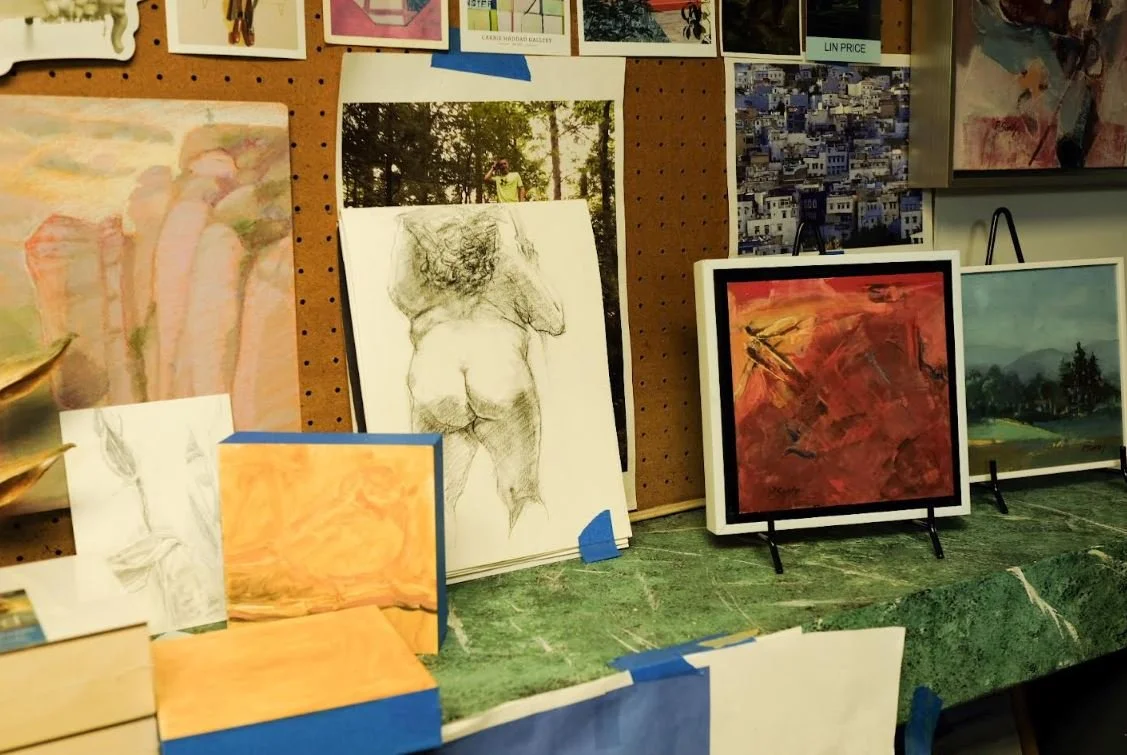
Photo Credit: Hongo David Robertson
Currently, Santy’s work is featured at Gallery at Axom Home in Rochester, where paintings are installed alongside carefully curated furniture and interior design elements. She enjoys seeing how paintings transform when placed into lived environments rather than isolated white walls. The relationship between artwork, light, furniture, and architecture creates entirely new conversations. Meanwhile, she is also preparing for a collaborative exhibition inspired by the woods surrounding Le Moyne College. The project brings together painters, poets, musicians, photographers, and scientists to explore nature through multiple artistic disciplines. For Santy, the collaboration offers another reminder that art does not happen in isolation. It grows through shared observation, dialogue, and experience.
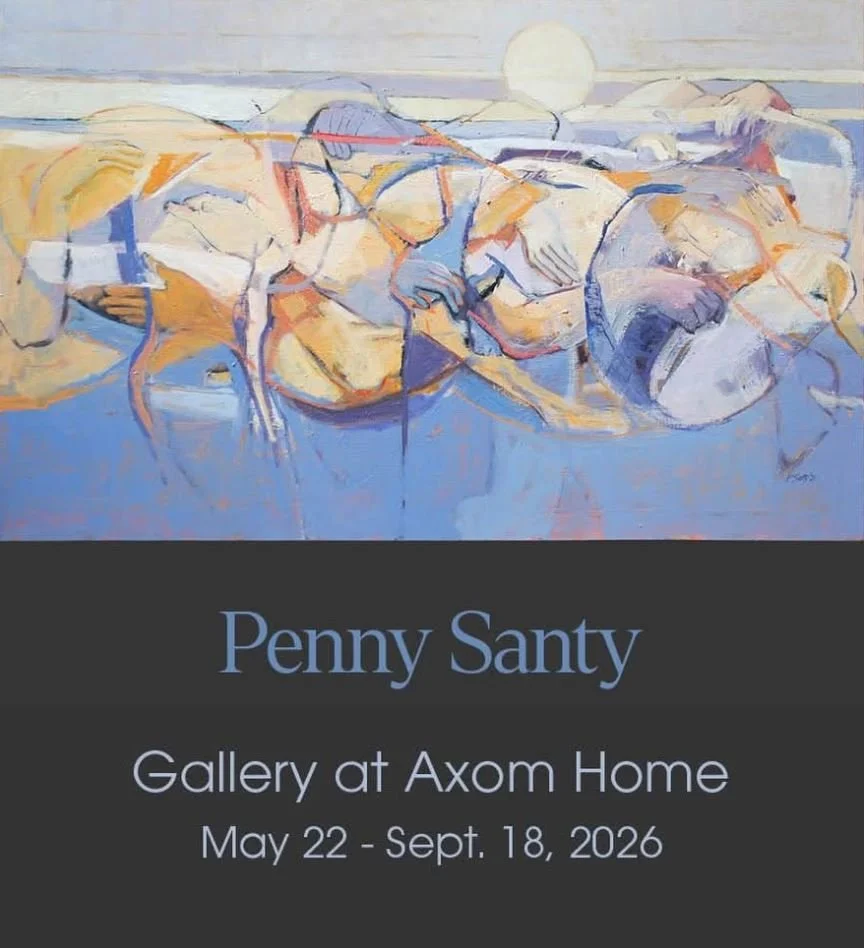
Penny Santy’s ‘River of Humanity’ 48”x30”
When asked how she knows a painting is finished, she pauses. There is no formula. Sometimes a painting hangs in her home for weeks before she decides whether it succeeds. Other times she paints over older works entirely, sacrificing finished surfaces to begin again. The answer, ultimately, comes down to feeling. A painting announces itself when it finally carries the emotional charge she is searching for.
Inside the studio behind Santy Glass, surrounded by brushes soaking in cans and canvases still drying, Penny Santy continues that search every day. Her paintings are not attempts to explain the world neatly. They are efforts to feel it more deeply and to invite others into that same experience. For Santy, art is less about certainty than about remaining open: open to memory, open to risk, open to the possibility that a painting might unexpectedly move someone in ways neither artist nor viewer fully understands. It’s all about rebellion, and experimentation and pushing boundaries.
For more information about Penny Santy and her artwork: www.pennysanty.com