
Dennis Kinsey: The Art of Flow, Journey Through Painting and Music
Dennis Kinsey has spent much of his life moving between disciplines that, at first glance, seem unrelated. He has been a touring rock musician, a political researcher, a university professor, and, for the past quarter century, a painter whose work has evolved from vividly colored buffalo inspired by the American Southwest to increasingly expressive abstract compositions. Yet speaking with him in his home, surrounded by paintings in various stages of completion, the transitions feel less like career changes than different expressions of the same curiosity.
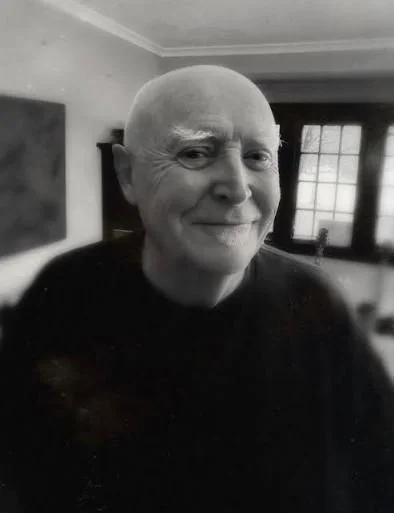
Photo Credit: HonGo David Robertson
His home studio reflects that progression. Canvases lean against the walls, completed works share space with experiments, and the latest abstract paintings reveal layers of paint, handwritten marks, collage elements, and energetic drawing. Music still occupies an important place in the room, but painting has gradually become the center of his creative life.
Kinsey grew up in East Liverpool, Ohio, once known as the pottery capital of the world. During its industrial peak, more than 150 pottery companies operated there, producing everything from everyday dishes to decorative ceramics. Nearly every family, including his own, had connections to the industry.
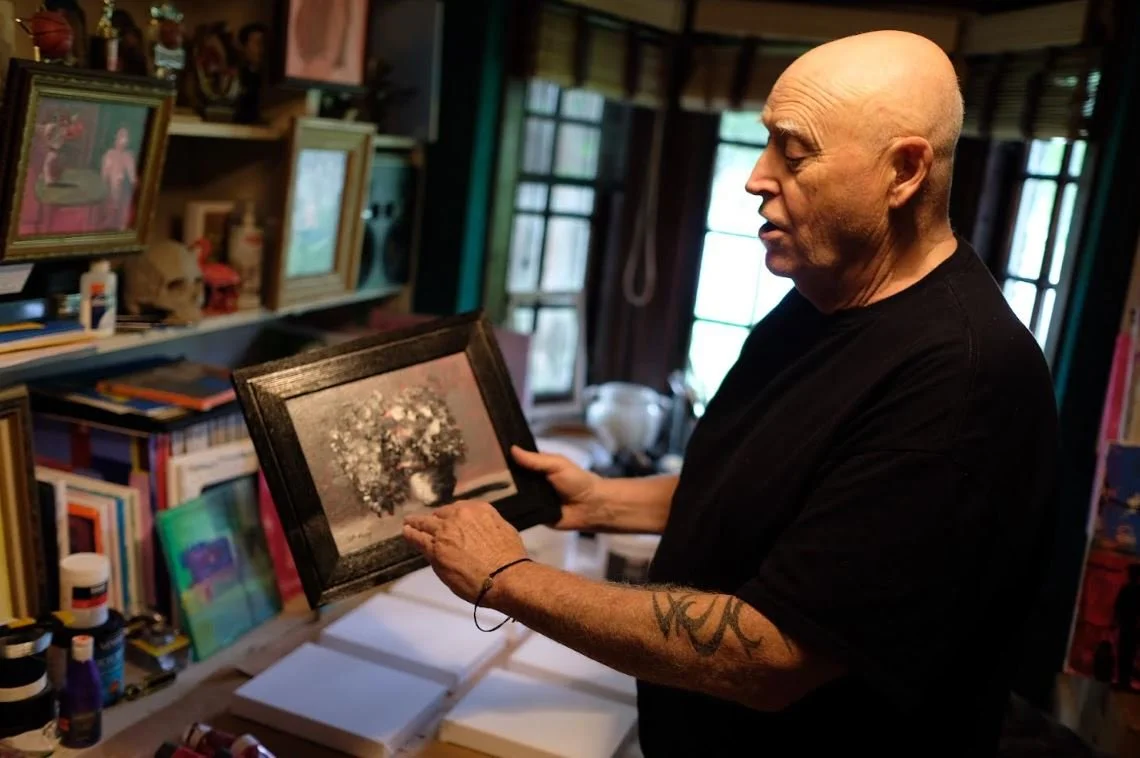
Photo Credit: HonGo David Robertson
"I worked in the pottery," he recalls. "Everybody in East Liverpool worked in the pottery at one point." The town itself would eventually decline as manufacturing disappeared, leaving only a handful of companies behind, including the well-known Fiesta dinnerware manufacturer. But during Kinsey's youth, it was a bustling working-class community where music became his escape.
By seventeen he had formed a band with friends. Shortly after graduating from high school, they loaded their equipment into a U-Haul trailer, crossed into West Virginia for one final local performance, then drove overnight to Jersey Shore to begin their first professional summer season. "We were playing six nights a week," he remembers. "I wasn't even old enough to be in the bars where we were performing."
The relentless schedule became an education of its own. Three rehearsals each week, six or seven performances, and constant exposure to audiences quickly forged the musicians into a tight ensemble. They performed classic rock alongside dance music popular during the mid-1970s, covering artists such as David Bowie, Bachman-Turner Overdrive, the Rolling Stones, and Kool & the Gang.
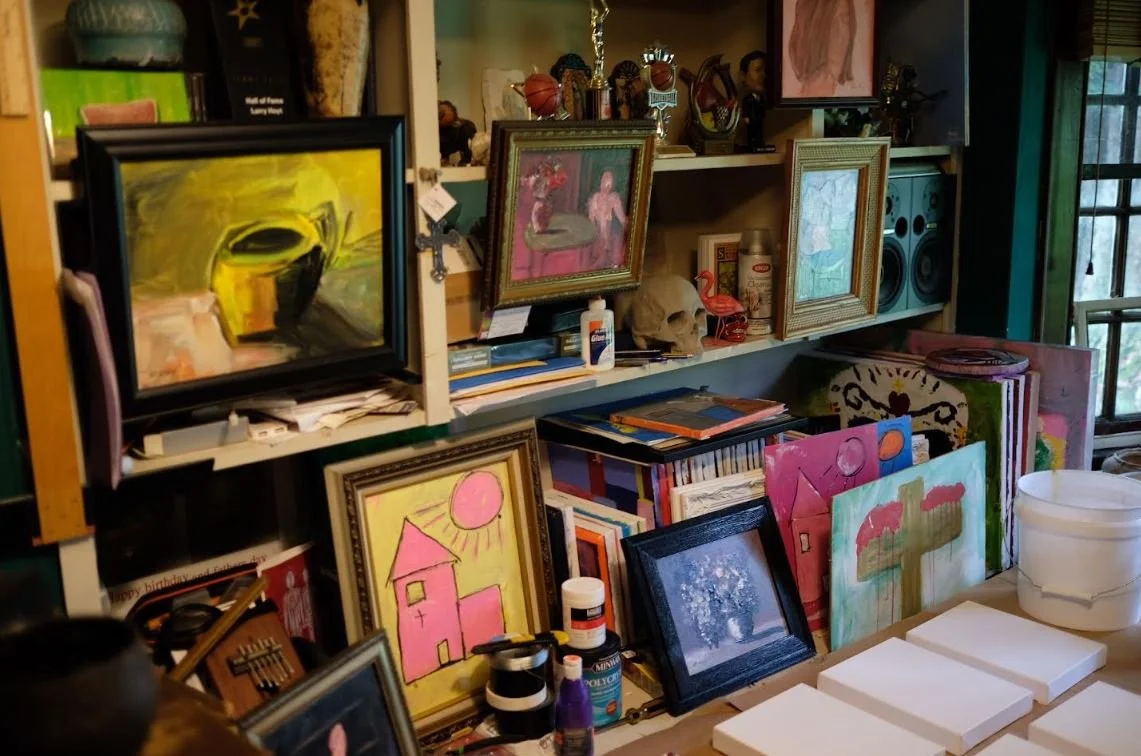
Photo Credit: HonGo David Robertson
One regular audience member changed the direction of the band's future. Jack Salveson, manager of the Cape May County Airport and a former music industry professional who had once coordinated entertainment tours for American troops in Vietnam, began attending their shows. Impressed by the group's musicianship, he offered to manage them and arranged a Canadian tour after the Jersey Shore season ended. Unfortunately, the opportunity never materialized. Before leaving for Canada, the band returned home to Ohio, reconnected with old friends, and gradually drifted apart. "We came back home," Kinsey says. "The band immediately broke up." Like many young musicians, they never quite recreated the chemistry they had developed on the road.
With music temporarily behind him, Kinsey enrolled at Kent State University's East Liverpool campus, initially viewing college as practical insurance in case the dream of becoming a professional musician faded. He chose political science. After earning his bachelor's degree, he discovered there was little demand for graduates with that specialty, so he stayed to complete a master's degree while serving as a graduate assistant. During that period, he worked with a professor who organized annual campaign management institutes that brought together politicians, pollsters, media consultants, and campaign professionals.
One guest speaker, Cleveland pollster Robert Dykes, would unexpectedly redirect Kinsey's career. Dykes hired him to join Decision Research Corporation, where Kinsey spent the next decade conducting public opinion research, polling, and political consulting throughout Ohio. The work fascinated him intellectually. He studied voter behavior, persuasion, communication, and public opinion, but eventually recognized a limitation. Everything they learned belonged exclusively to clients. "We'd do the research, advise the campaign, and then it went on the shelf."
At the same time, he found himself increasingly enjoying invitations to speak at colleges and conferences, explaining research methods, campaign strategy, and political communication. Teaching became more rewarding than consulting. Despite promising himself after graduate school that he would never return to academia, he reconsidered.
After exploring communication studies through graduate coursework at Cleveland State University, he applied to doctoral programs across the country, including Stanford University. To his surprise, Stanford accepted him. There he studied mass communication under scholars whose work he had long admired, completing a Ph.D. before entering one of academia's notoriously competitive job markets. Temporary teaching appointments at Stanford and Boston University eventually led to three full-time offers. One came from the University of New Mexico, another from Boston University, and the third from Syracuse University.
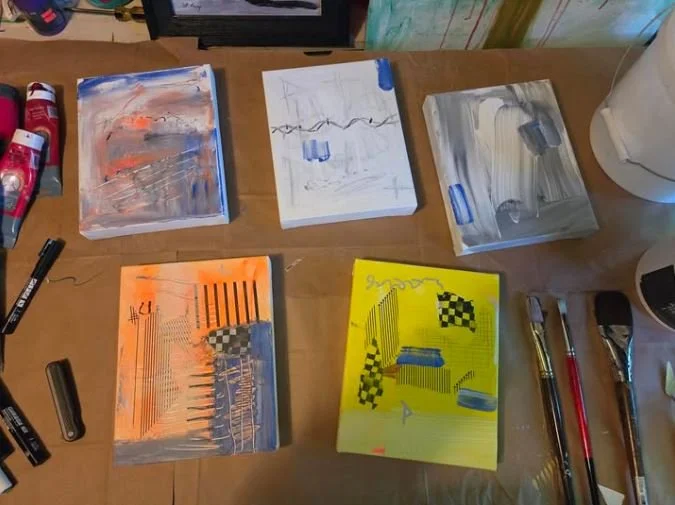
Photo Provided by Dennis Kinsey
Although New Mexico appealed to him personally, Syracuse offered the strongest combination of academic opportunity, respected colleagues, and financial stability. He arrived in Syracuse in 1995 and has remained ever since.
Painting entered his life several years later through an entirely different circumstance. His daughter had recently been born and followed an almost perfectly predictable schedule; two hours awake followed by two hours asleep. Those quiet afternoons became creative opportunities. "I had these two-hour windows," he says. "So, I decided I was going to start painting."
Art had always fascinated him. Long before he ever picked up a brush, he had admired the Impressionists and collected books devoted to painters whose work emphasized color, emotion, and expressive interpretation over realism. Following advice from Edgar Degas that artists should paint the same subject repeatedly, Kinsey chose an unlikely companion: the American buffalo. The choice reached back to childhood.
At about eight years old, while attending a company picnic in Pennsylvania with his father, he wandered away from a softball game and encountered a small herd of buffalo grazing in a distant field. "I thought buffalo were extinct," he says. "It was like seeing a dinosaur," Kinsey laughed.
The experience stayed with him for decades. Later, during a trip to New Mexico, he purchased a hand-carved howlite buffalo that became the model for his earliest paintings. Working in acrylics, partly to avoid oil paint fumes around a newborn, he produced dozens of colorful interpretations influenced by Southwestern painter John Nieto.
Initially he expected the series to end after only a few paintings. Instead, each canvas taught him something new. "You learn about the subject, you learn about paint, you learn about creativity." Over time, he estimates he painted roughly fifty buffalo, each one pushing him toward greater confidence while gradually leading him away from direct representation and toward increasingly personal interpretations.
As his confidence grew, Kinsey realized he needed instruction beyond what he could teach himself. He enrolled in painting and drawing classes for non-art majors at Syracuse University, where one assignment required students to copy the work of an artist they admired. While many classmates selected Monet or other familiar masters, Kinsey chose one of his greatest influences, the New Mexico painter John Nieto.
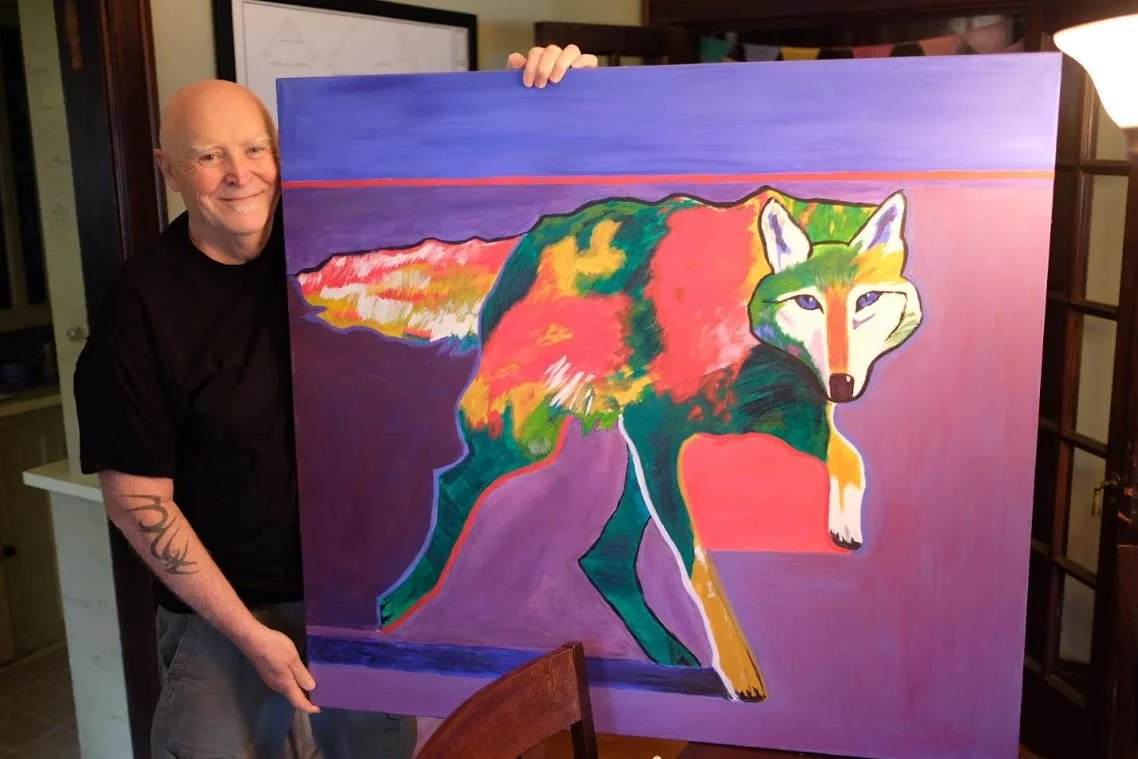
Photo Credit: HonGo David Robertson - - “Nieto’s Wolf”, 40” x 44”
The choice carried special meaning. During a visit to the gallery representing Nieto's work, Kinsey and his wife happened to arrive just before a new exhibition was scheduled to open. Although the show had not yet been installed, the gallery staff brought several paintings from the back room for them to see. One in particular, a striking portrait of a blue-eyed wolf, stayed with him. For his class assignment he recreated the painting, carefully stretching his own canvas and following the same dimensions as the original. In hindsight he laughs about that decision, noting that museum copyists traditionally work at different scales to distinguish reproductions from the originals. The exercise became one of the most valuable lessons of his artistic education. His instructor observed that although the colors were vibrant, the painting lacked unity. With a simple wash of diluted blue paint, the composition suddenly came together. "It taught me something I've used ever since," Kinsey says. "Sometimes a painting needs one final layer to bring everything into harmony." The experience also revealed something unexpected. The finished painting looked remarkably like a John Nieto original. "I almost regret painting it," he admits. "Some of the mystery disappeared because I realized I could do it."
Rather than discouraging him, that realization expanded his confidence. If he could understand how one admired artist constructed a painting, perhaps he could begin discovering his own visual language. His influences continued to grow. The elongated figures of Amedeo Modigliani appealed to him, while the luminous color fields of Mark Rothko became increasingly important as he drifted toward abstraction. Those seemingly unrelated artists found common ground in Kinsey's work, where recognizable imagery slowly dissolved into color, gesture, texture, and atmosphere.
Music and painting have always occupied different seasons of his life. There were years when performing dominated his creative energy, and others when painting became the primary focus. Today, if asked to choose between the two, he answers without hesitation. "These days, I'm a painter."
That doesn't diminish the importance of music. His son is a drummer, and the two still enjoy playing together at home. Until recently Kinsey regularly shared short musical performances online, recording hundreds of songs over the years. But after painting steadily for more than two decades, he made a conscious decision to take his artwork more seriously. He built a website, began exhibiting more consistently, and focused on placing paintings into collections rather than simply stacking them in his studio.
Collectors now own his work across the United States and overseas. One of his buffalo paintings found its way to Hawaii. Another traveled home with a colleague returning to Glasgow, Scotland after attending a conference in the United States. That unexpected sale led to several additional commissions after friends saw photographs online. The renewed interest briefly tempted him back to the buffalo that first inspired him. "Maybe I should paint buffalo again," he says with a smile.
Today, however, abstraction occupies most of his attention. His process is far from orderly. Unlike artists who carefully plan every stage before touching the canvas, Kinsey accepts uncertainty as part of the work. In fact, he expects it. "I love the process," he says. "But while I'm doing it, I almost hate it." The contradiction makes perfect sense as he explains it. Early stages feel confusing. The painting seems to resist him rather than cooperate. He often worries that it is going nowhere, yet experience has taught him not to trust those feelings. One rule has become especially important. "Don't fall in love with it too soon." If he becomes satisfied too early, the painting stops growing. Instead, he continues pushing, scraping, drawing over surfaces with paint markers, adding layers, removing others, and allowing the work to evolve over days or even weeks.
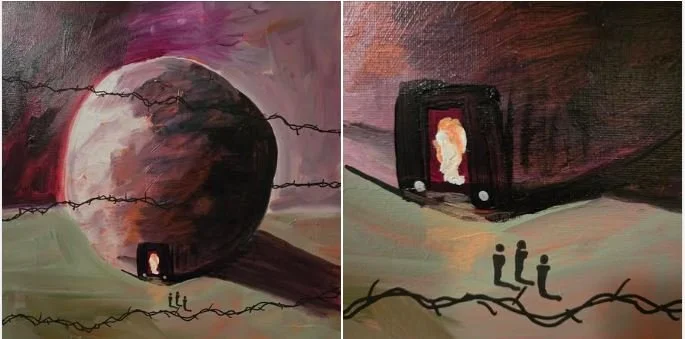
Photo Provided by Dennis Kinsey, Titled: “Entrance” 20”x16”
Only after hanging a painting on the wall does he begin to evaluate it. He studies it in changing light, walking past it in the morning, late at night, and throughout the day before deciding whether it is truly finished. Sometimes a single line or a few drawn marks transform an uncertain canvas into a successful one. That slow process explains why his studio occupies a room within his home rather than a separate building.
"I couldn't have a studio somewhere else," he says. "I'd have to bring everything home anyway." The convenience allows him to walk in before sunrise, add a few brushstrokes, then leave again. Inspiration doesn't follow business hours, and neither does his work. Kinsey explains, like many painters, he enters what psychologist Mihaly Csikszentmihalyi famously described as "flow." Once painting begins, time disappears. Music fades into the background. Hours pass unnoticed. "I just disappear into it."
His work has also become increasingly experimental. Painting pens introduced another vocabulary of marks layered over acrylic surfaces. Fragments of collage, handwritten text, and torn paper now appear alongside broad fields of color. Images that once dominated his paintings, the buffalo, sacred hearts, recognizable figures—have gradually exploded into abstract forms that invite interpretation rather than explanation.
He continues learning from every painting. An abstract painting instructor once challenged students to stop worrying about expensive art materials, demonstrating techniques with ordinary house paint and pages from a New York City telephone directory glued directly onto canvas. The lesson wasn't really about materials. "If the work is any good," the instructor told his class, "Someone will preserve it."
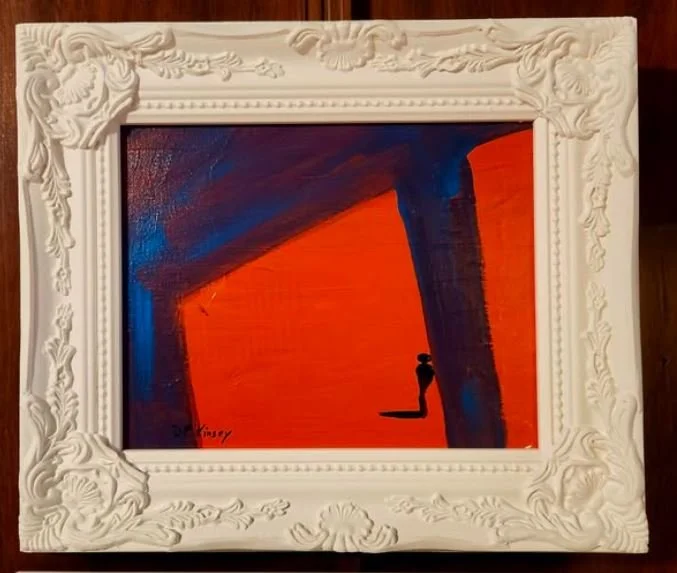
Photo Provided by Dennis Kinsey - - “Shadow” 8” x 10” unframed; 12” x 14” framed
Kinsey has carried that philosophy with him ever since. Although he once resisted painting over older works, believing every canvas should remain untouched, practicality eventually won out. If a painting no longer felt successful, it simply became the foundation for another. "I needed the canvas," he says matter-of-factly.
The decision reflects his view that art is a continuing conversation rather than a finished record. That same practical attitude extends to selling his work. While financial success was never the reason he painted, he now believes paintings deserve lives beyond his studio walls. "I want to get them out there." Some works remain with family members. Others have become too personal to part with. But he has little interest in allowing stacks of finished paintings to remain hidden indefinitely. "Part of art, for me, is appreciation," he says. "If they're just sitting here in my studio, that's great for me, but I want other people to live with them."
His paintings have appeared in exhibitions throughout Central New York, including shows at ArtRage Gallery and the Rochester Contemporary Art Center's annual 6x6 exhibition, where one piece sold almost immediately. He has participated in live painting events benefiting ALS research and recently completed his first commissioned work, a large peacock painting created for colleagues who wanted a centerpiece for their home. Even after twenty-five years, curiosity remains his strongest motivation. Every new canvas represents another question rather than another answer.
As our conversation winds down, Kinsey walks through his studio, pulling paintings from the walls and describing the evolution of ideas from one series to the next. The room contains decades of exploration, yet nothing suggests someone who believes he has arrived. Instead, there is the unmistakable feeling of an artist still searching.
That search has carried Dennis Kinsey from Ohio potteries to Jersey Shore stages, from political polling to university classrooms, from brightly colored buffalo inspired by the Southwest to richly layered abstractions that continue to evolve. Each chapter has informed the next, not through any predetermined plan, but through a lifelong willingness to follow curiosity wherever it leads. For Kinsey, painting, like music, is less about reaching a destination than remaining open to discovery. Every finished canvas points quietly toward the next blank one waiting in the studio.
Contact Dennis at: dfkinsey@syr.edu