
On an August afternoon the elevator doors opened onto the 3rd. floor of Syracuse's Delavan Art Center, where painter Mark Raush has spent decades building a quiet, persistent body of work. His studio is one of the building's older, larger spaces, filled with light and tall canvases, stacks of paintings, loose studies, and the evidence of a lifetime devoted to painting. Sunlight pours through the east-facing windows, revealing surfaces layered with color, collage, and years of experimentation.
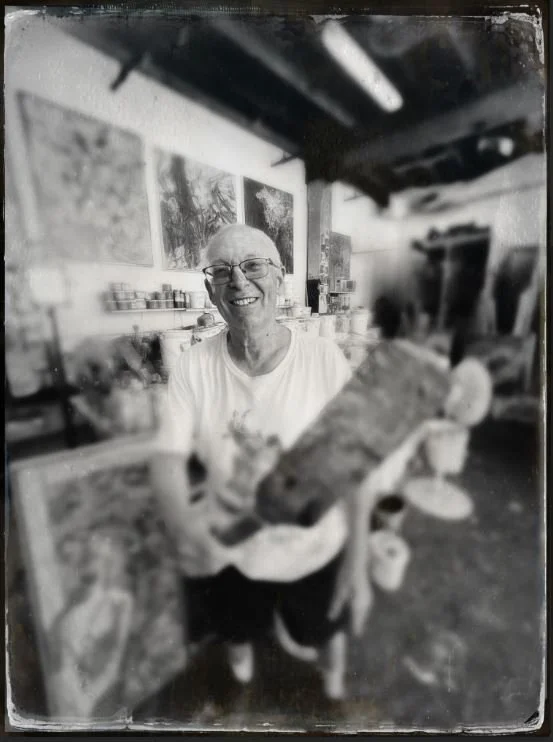
Photo Credit: HonGo David Robertson
Conversations with artists rarely follow a straight line. Raush is no exception. Before discussing paint, composition, or the history of his work, he began talking about age. At seventy-four, he said, there is no pretending otherwise. Yet he speaks about growing older with humor instead of resignation. He enjoys the freedom that comes with it, the ability to care less about appearances and more about the things that continue to matter. The energy is still there, particularly in the mornings, even if evenings now belong more often to dinner with his wife, artist Judi Witkin, and an earlier bedtime than years ago.
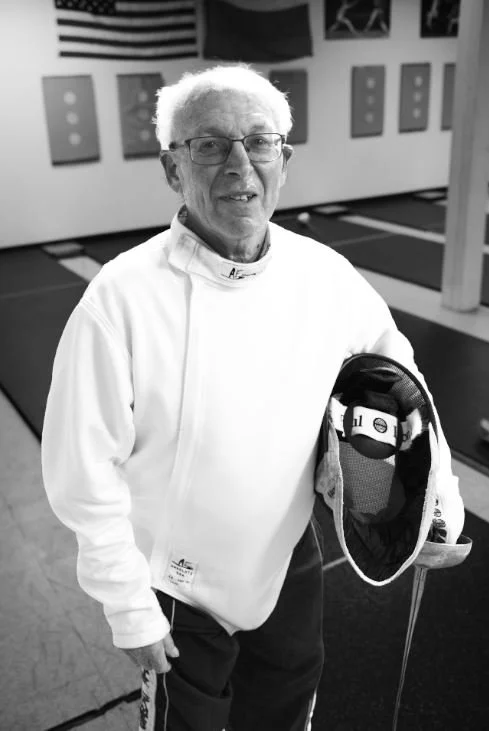
Photo Credit: HonGo David Robertson
That acceptance of time seems reflected throughout his artwork. Nothing about Raush suggests someone chasing trends or trying to reinvent himself to fit the contemporary art market. Instead, he has continued to build upon ideas that have interested him for decades, allowing them to evolve naturally rather than forcing change.
One unexpected thread in his life is fencing. What began as curiosity became a passion that lasted more than twenty years. Around the age of fifty-three, during a particularly turbulent period when other people's problems seemed to weigh heavily upon him, he noticed an advertisement for fencing classes. On impulse, he enrolled.
The decision changed far more than his exercise routine. He immersed himself in tournaments, learned the technical differences between foil, épée, and saber, and studied under Bulgarian coach Lubo, whose own career reached the international level. Raush became fascinated not only by the sport itself but by its history. Following the collapse of the Soviet Union, many elite Eastern European coaches came west as their national sports programs disappeared. Suddenly, Syracuse offered access to instructors whose knowledge had been shaped by generations of European fencing traditions.
For Raush, fencing became both physical and intellectual. He describes épée as the discipline closest to an actual duel—a contest built on patience, strategy, and anticipation rather than brute aggression. Learning to slow down, wait, and think several moves ahead proved just as important as mastering the footwork.
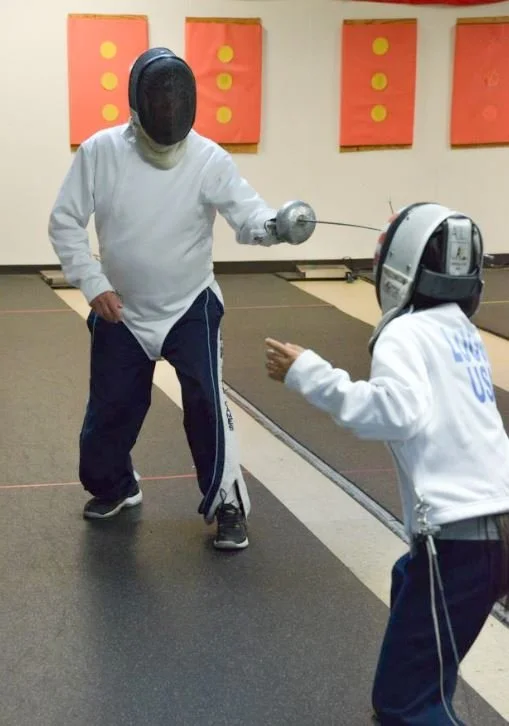
Photo Credit: HonGo David Robertson
"I had to learn patience," he admitted.
The sport also introduced him to remarkable people whose personal histories stretched across continents and wars. Older Hungarian fencers shared stories of cavalry officers, wartime survival, the 1956 Hungarian Revolution, and Olympic competition. Those conversations appealed to Raush's lifelong fascination with history.
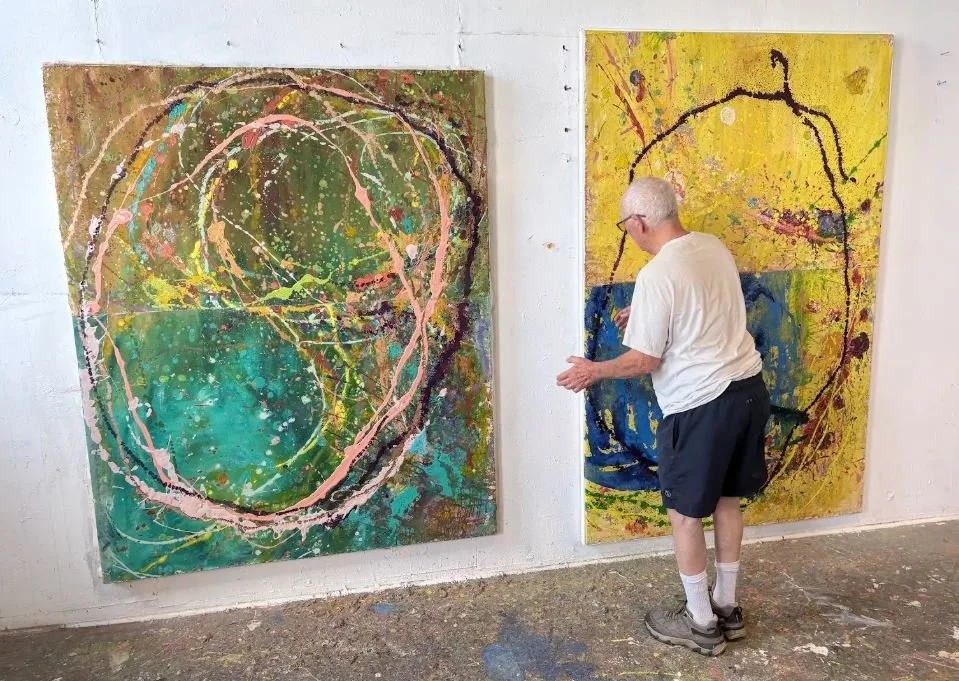
Photo Credit: HonGo David Robertson
The parallels with painting are difficult to ignore. Both demand years of repetitive practice before instinct begins to replace conscious effort. Both require discipline, timing, and the willingness to fail repeatedly in pursuit of improvement.
Long before fencing entered his life, however, art had already established itself. His father, Stan Raush, possessed artistic talent himself. Although not a professional artist, he painted and drew with considerable skill despite being colorblind. Like many gifted people of his generation, practical responsibilities eventually outweighed artistic ambitions, but the creative impulse remained visible in the family home.
When Mark turned thirteen, his mother suggested he use his father's oil paints. He never really stopped. Drawing became second nature. His school notebooks quickly filled with sketches instead of lecture notes. Teachers recognized his ability almost immediately. His high school art teacher believed so strongly in his talent that she personally visited his parents to encourage them to consider sending him to art school. His mother worried about practicality. How could someone make a living as an artist? Looking back, Raush admits she wasn't entirely wrong. Even today, he encourages young artists to understand the economic realities of pursuing a creative life. Passion alone rarely pays the bills.
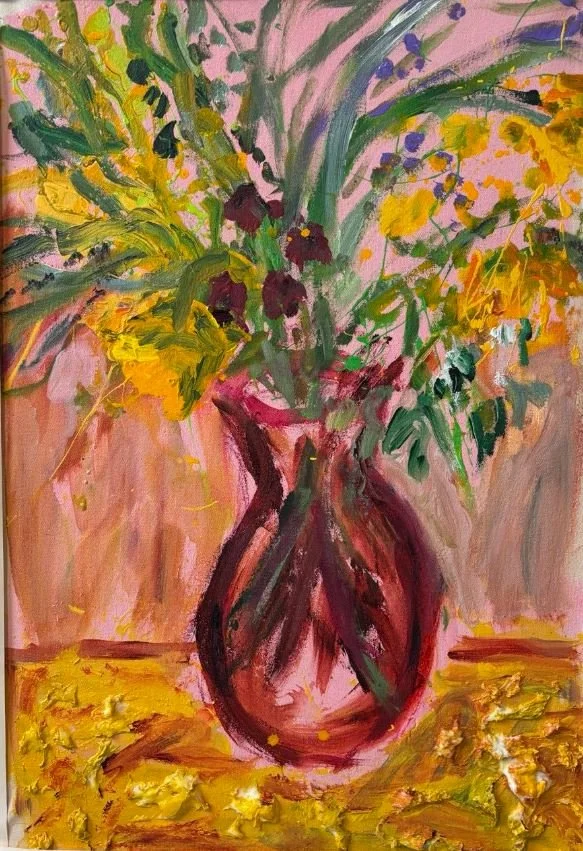
Photo Provided by Mark Raush. “Maroon Vase, 2025, Acrylic on canvas, 33”x22.5”
Fortunately, his father quietly supported the idea. Only years later did Raush fully understand how much encouragement his father had offered behind the scenes. "I was lucky," he reflected. That support led him to Syracuse University, where he entered the painting program in 1970.
The move north would shape the rest of his life. Like many young artists, Raush initially imagined returning home after graduation. Instead, relationships, friendships, and opportunities gradually rooted him in Central New York. By the mid-1970s he had established a studio at the Delavan Art Center, beginning a relationship with the building that has now stretched across nearly half a century.
He has worked in his current studio since 1979. It is one of the few remaining large studios from an earlier era, before many of these spaces were divided into smaller units. Standing inside, it is easy to understand why scale became important to his work. The generous ceiling height and expansive walls invite larger paintings. Raush himself acknowledges that studio size influences artistic decisions. A smaller room encourages intimate canvases; a large room invites risk.
The Delavan itself has changed enormously over the years. When Raush first worked there, the building was still part warehouse. Forklifts operated overhead. Dust and debris occasionally fell through cracks in the floor into his studio below. Conditions were hardly romantic, but artists adapted because affordable workspace mattered more than comfort.
Like much of Syracuse's arts community, the Delavan evolved through persistence rather than sudden transformation. Raush's own work has evolved just as steadily. In college he concentrated largely on figurative painting. Years later, when fellow artist and longtime friend Scott Bennett suggested sharing the cost of a life model, Raush returned to drawing from observation. He produced numerous figure drawings, appreciating the drawings themselves more than the backgrounds surrounding them.
Eventually an idea emerged. Rather than treating the drawings as finished works, he began cutting the figures from the paper entirely. Those cut-out forms became elements in new mixed-media compositions assembled on canvas. The backgrounds transformed into collaged environments layered with paint, texture, and additional imagery.
The process altered his work dramatically. Standing before one finished piece, the layered surfaces reveal themselves only at close range. Figures physically project from the canvas. Edges cast tiny shadows. Texture becomes part of the composition instead of simply an illusion created through paint.
Raush speaks about these discoveries with remarkable simplicity. He rarely describes them as breakthroughs. Instead, he explains them almost casually. "I cut out the figure... put it on canvas... collaged stuff... and see what happens." That phrase—see what happens—captures much about his philosophy.
Throughout the studio sit paintings assembled from earlier paintings. Older canvases are cut apart, rearranged, glued together, and transformed into entirely new works. Paintings from the early 1980s reappear inside contemporary compositions. Circular forms painted decades earlier can suddenly become structural elements in new abstractions. Nothing is wasted. Earlier paintings remain a reservoir of possibilities, waiting to become material for his next work.
One floral painting began after members of a local food cooperative encouraged participants to take home flowers alongside their vegetables. Raush brought bouquets back to the studio, arranged and painted them. Others were painted directly outdoors. Some began from observation before moving into abstraction. Others started with photographs. For Raush, the source matters less than the finished painting.
He has little interest in photographic realism. "If you wanted realistic," he observed with a smile, "you'd take a photograph." Instead, he seeks rhythm, movement, structure, and color relationships that photography alone cannot provide.
That willingness to abandon literal representation extends throughout his studio. Large abstract paintings filled with floating circles coexist comfortably beside expressive floral works and layered figurative compositions. Rather than representing unrelated bodies of work, they feel like different conversations conducted by the same painter over many years. Financial reality, however, required more than painting.
Following college, Raush held a succession of jobs while continuing to work in the studio almost every evening. He worked at the Syracuse University Bookstore, refinished furniture, delivered high-end furnishings for Bronson Interiors, worked with developmentally disabled adults, and eventually earned a master's degree in education.
Teaching art became another chapter of his life. Like many art educators, permanent positions proved difficult to secure. He taught in Canastota and filled maternity-leave positions throughout Central New York, working in school districts from Red Creek to Fayetteville-Manlius and taking on whatever opportunities came his way.
Throughout it all, the routine remained remarkably consistent. Go to work. Come home. Eat dinner. Go to the studio. Paint. The pattern repeated itself year after year.
One of the pivotal moments in his career came through a letter written largely on hope. As a young painter in his twenties, uncertain how artists found galleries or professional recognition, Raush mailed slides of his paintings to influential art critic Clement Greenberg. He expected nothing. Instead, Greenberg replied.
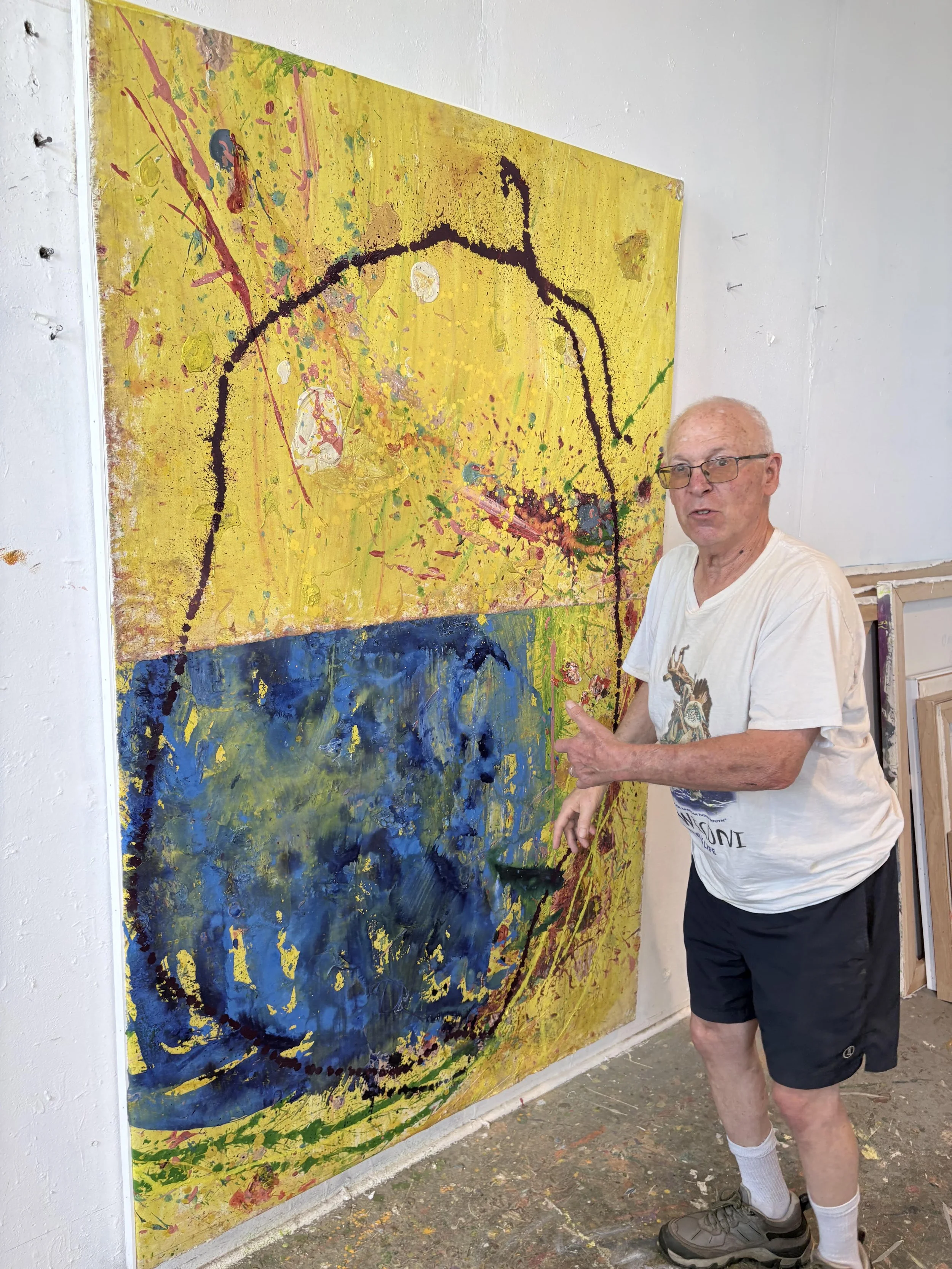
Photo Credit: HonGo David Robertson, “Sun and Sky” acrylic on canvas, 79”x51”
The correspondence developed into a relationship that lasted from the late 1970s until Greenberg's death in 1994. Raush made repeated trips to Clem’s summer home in Norwich, New York, as well as to his home in New York City, transporting paintings in his car for Greenberg’s critiques. Those visits expanded into relationships with other artists, critics, and exhibitions while introducing him to a wider professional art world than Syracuse alone could provide.
He also participated in Triangle Artists' Workshop, bringing together artists from the United States, Canada, and the United Kingdom for intensive periods of shared work and discussion. These experiences connected him to broader conversations in contemporary painting without requiring him to abandon Central New York.
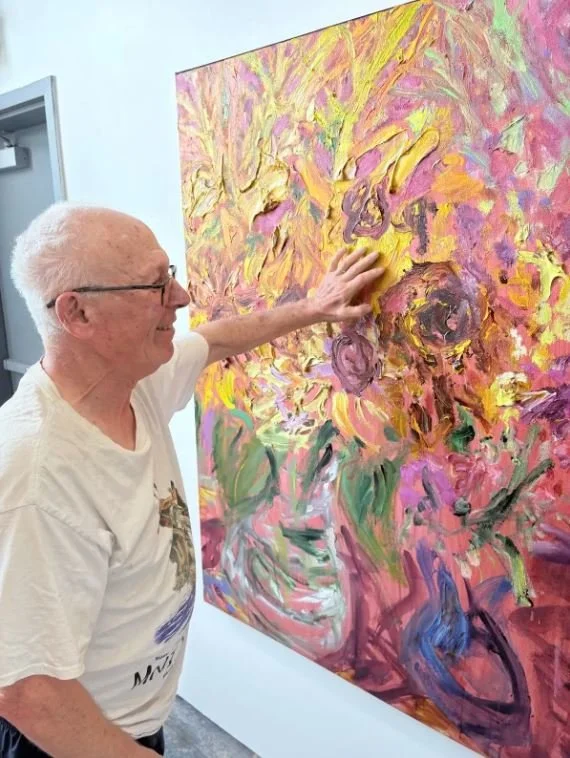
Photo Credit: HonGo David Robertson
Asked whether Syracuse adequately supports original contemporary art, Raush answers thoughtfully but honestly. Collectors certainly exist. Individual patrons have purchased significant amounts of his work over the years. Yet he believes appreciation for serious original painting remains limited compared to larger metropolitan areas. Traditional work often sells more easily than ambitious abstraction, particularly larger paintings requiring substantial wall space.
Even so, he never left Syracuse. New York offered visibility. Syracuse offered a life. The choice allowed him to keep painting on his own terms. None of that would have been possible, he readily acknowledges, without Judi.
An artist herself, originally trained in weaving, Judi provided not only companionship but stability. Raush credits her with making it financially possible for him to continue painting over the decades, when neither teaching nor selling his artwork could have provided enough income to support a household. He speaks about her contributions with genuine gratitude rather than sentimentality.
Artists often celebrate independence, but Raush openly recognizes that creative lives are frequently sustained through partnerships. Walking through his studio, paintings lean against walls several layers deep. Some date back decades. Others are fresh enough that the paint still seems to glow beneath the afternoon light. Nothing suggests an artist nearing retirement. Instead, the space feels active. Experimental. Unfinished.
Raush continues altering older paintings, building new surfaces, discovering unexpected compositions by literally rearranging his own history. There is a quiet confidence in that approach. After more than sixty years of painting, he no longer appears interested in proving anything. He simply continues working.
Standing before one textured canvas, he watches as changing light reveals surfaces invisible from across the room. Up close, every cut edge, brushstroke, and layer contributes to the painting's physical presence. The process has become the painting. The years have become part of the surface. And in a large east-facing studio inside the Delavan Art Center, Mark Raush continues adding another layer.
Mark’s Contact Information: mraush@twcny.com, or 315.657.8232