
On the morning of August 4, 2026, I drove to Roger De Muth's home and studio in Cazenovia, New York, expecting to spend a few hours with a painter. By the end of the afternoon, it was clear that describing Roger simply as a painter would overlook much of what makes his work so distinctive. He is an illustrator, educator, photographer, bookmaker, collector, designer, historian, and lifelong observer of the world around him. Those roles don't exist separately. Over decades they have gradually merged into a single creative practice, one that now fills every corner of his studio and continues to evolve with each passing year.
The first impression is one of organized abundance. Paintings lean against nearly every wall. Shelves are filled with handmade sketchbooks. Models occupy worktables. Antique frames wait for the right painting. Oversized objects, architectural studies, portraits, and works in progress share the same space. Pathways weave between projects that appear unrelated until Roger begins explaining how each belongs to something much larger.
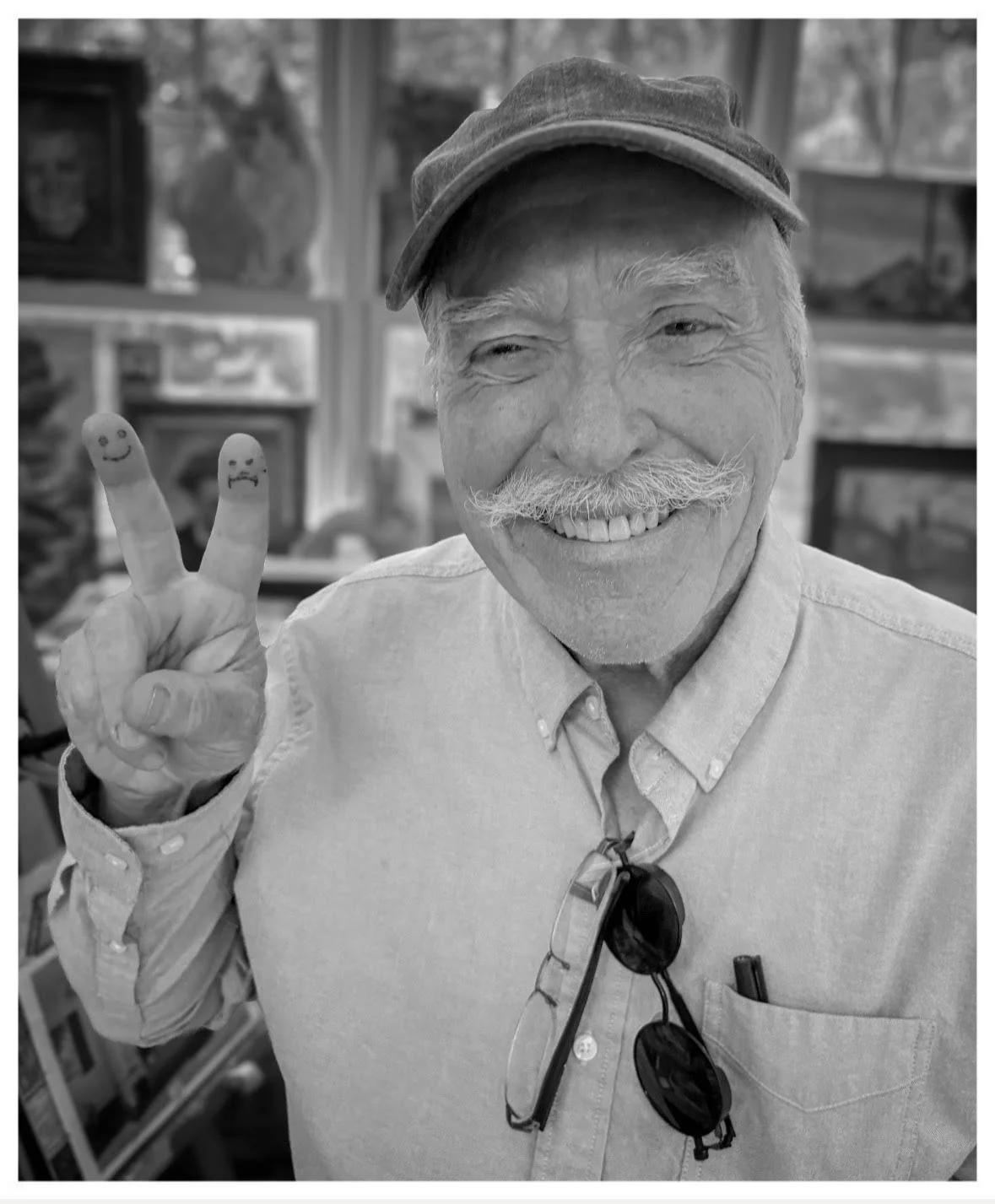
Photo Credit: HonGo David Robertson
Looking around the room, he smiled. "The trouble with this studio," he said, "is that I've been working on a project for eight and a half years... and the studio is completely filled." There was no frustration in his voice. If anything, it sounded like quiet satisfaction.
The project consuming the studio is unlike any exhibition Roger has attempted before. Rather than producing a collection of paintings for a gallery, he is creating an immersive environment where paintings, sculpture, architectural elements, handmade objects, sketchbooks, and memories all work together. Recently he assembled a scale model of the exhibition, not because the work was finished, but because sketches alone no longer communicated its complexity. Museum proposals had proven difficult to visualize. The model finally allowed others to understand how dozens of separate pieces would eventually become one complete experience.
The exhibition still has no permanent venue. Roger estimates it will require a space approximately twenty-four feet wide and more than seventy feet long. Finding a home large enough remains an unanswered question, yet uncertainty has never slowed the work. Instead, the project continues growing as new ideas emerge and older ones find stronger connections.
Miniature rooms stand beside oversized objects. A giant telephone waits beside a television. Old newspapers, pennies, benches, rugs, and carefully constructed architectural components all become part of the visual language Roger is developing. Some pieces are complete. Others exist only as sketches or partially finished constructions waiting for their place within the larger installation. "I don't quite know how all the pieces fit together yet," he admitted with a laugh, "but I have a pretty good idea of most of them." It is a refreshingly honest answer from an artist comfortable allowing ideas to develop naturally rather than forcing premature conclusions.
As we continued walking through the studio, Roger pointed toward what he considers the true heart of the exhibition. "The whole show is about these books." He reached toward shelves filled with handmade sketchbooks. At first glance they appear to be journals. A closer look reveals something much more significant.
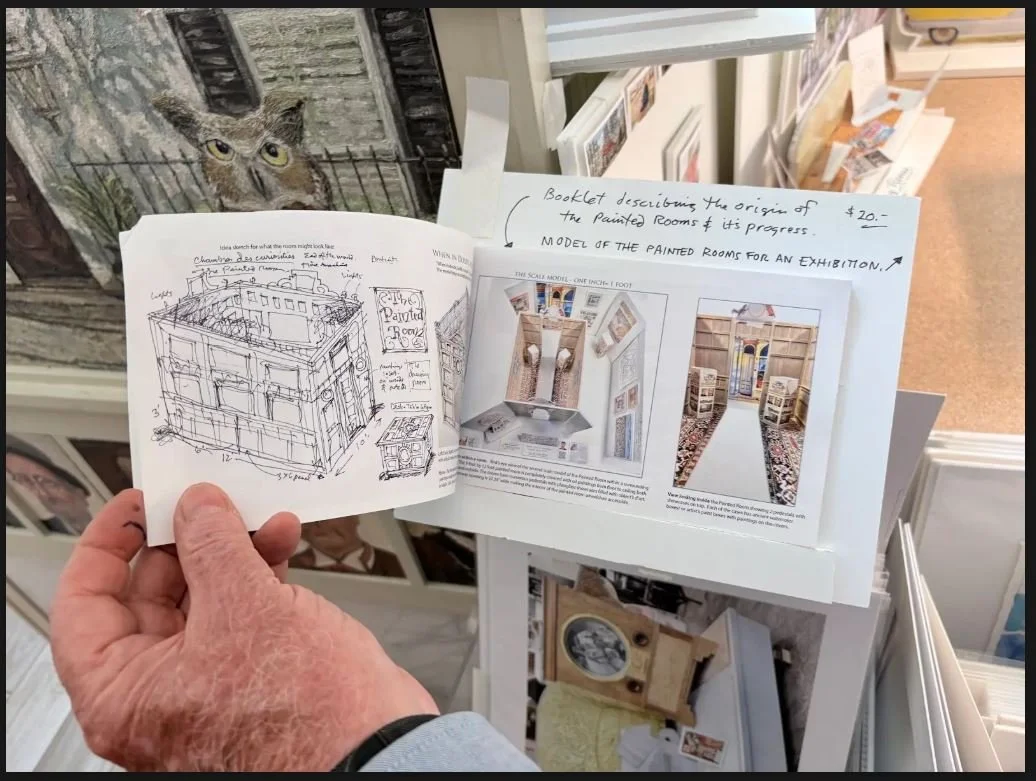
Photo Credit: HonGo David Robertson
Roger makes every one of them himself. Commercial sketchbooks never met his standards, so he began binding his own using 300-pound Arches hot press watercolor paper. The result is a series of substantial volumes that have become both working tools and finished works of art. Every page contains drawings, notes, watercolor studies, observations, design ideas, compositional experiments, or written thoughts that later find their way into paintings, sculptures, installations, and books.
There are no empty pages. Every inch has been used. Looking through them feels like following decades of uninterrupted thinking, each volume building upon the last. The sketchbooks document not only finished ideas but also the thousands of small decisions that eventually shape Roger's larger body of work.
His materials are chosen with equal care. Many drawings begin with waterproof Higgins ink applied using an Esterbrook No. 757 school pen nib mounted in a custom holder made by Central New York coppersmith Jude Ferencz - metal sculptor. The tiny ball at the end of the nib, originally designed to keep schoolchildren from digging into paper while learning cursive writing, produces exactly the line quality Roger has preferred for years.
He experiments constantly. Some drawings receive watercolor washes. Others develop rich sepia tones. Sometimes coffee becomes part of the process, naturally reacting with the ink to create unexpected color shifts.
When I jokingly asked whether he had ever painted with blueberry juice or beet juice, Roger didn't hesitate. "If it was on a plate and it was nearby, I would have used it." The answer perfectly captures his approach to making art. Nothing is too precious. Materials exist to serve ideas, and curiosity often matters more than convention.
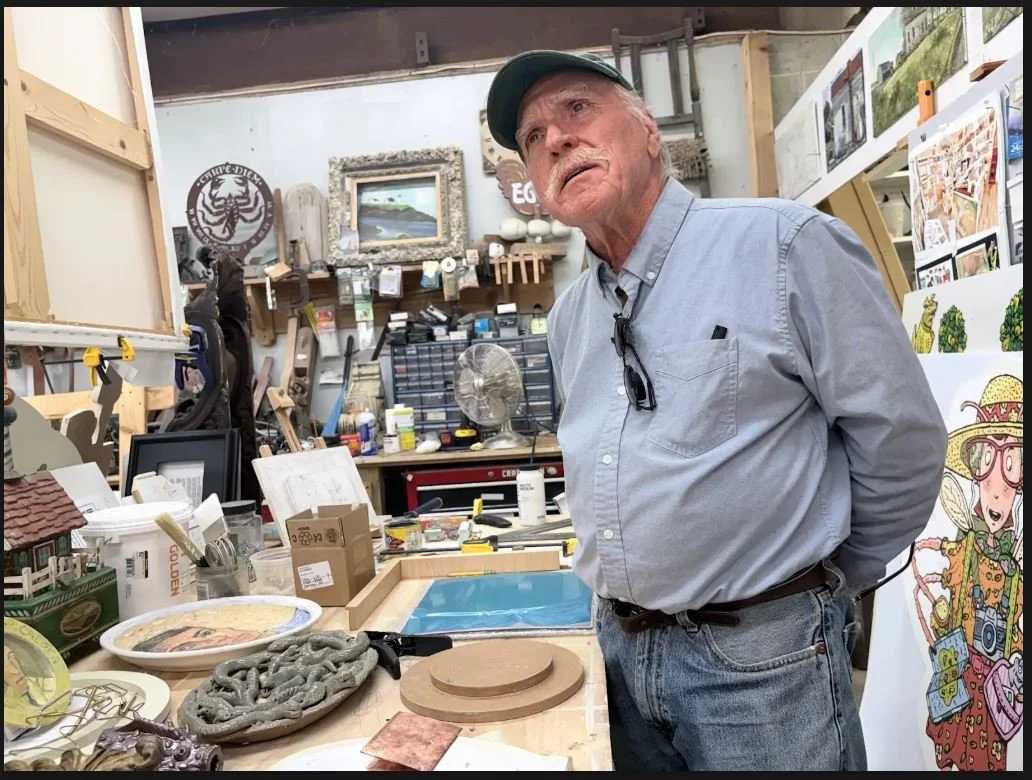
Photo Credit: HonGo David Robertson
Those sketchbooks have become so important that Roger has begun considering ways to enlarge them dramatically for exhibition. One possibility is producing oversized versions several feet tall, allowing visitors to experience the drawings at a scale impossible with the originals. Another involves projecting hundreds of scanned pages digitally, making the contents accessible while protecting the actual books from handling. Designing the exhibition has become an exercise in balancing accessibility with preservation. The books are meant to be experienced, yet they must also survive.
That challenge reflects Roger's broader philosophy. Throughout our conversation he repeatedly returned to the importance of preserving things that might otherwise disappear. Walking deeper into the studio, it became increasingly clear that Roger does not think in terms of individual paintings. He thinks in environments. Portraits wait beside landscapes. Architectural studies lean against dioramas. Display cases hold artist-made tools and carefully constructed objects destined for future rooms within the exhibition.
Nothing feels isolated. Every piece belongs to something larger. Roger wants visitors to experience the exhibition much as I experienced his studio. Paintings will wrap around the upper walls. Display cases will present sketchbooks, handmade books, paint boxes, and drawing tools. Visitors won't simply view finished artwork; they'll move through the process that produced it.
It is an ambitious undertaking, but one grounded in decades of disciplined work rather than spectacle. Photography occupies another essential role within that process. Roger speaks openly about painting from photographs. For him, the camera has never been a shortcut. It is another sketchbook, another means of observing the world before translating it into paint. "I take unbelievable amounts of photos," he said matter-of-factly.
Years of photographing architecture, landscapes, people, and everyday life have produced an enormous visual archive. Today, digital tools occasionally help simplify backgrounds or isolate a tree from its surroundings before he begins painting, but technology never replaces observation. It simply removes distractions so composition can become clearer. Photography allows Roger to collect moments. Painting allows him to interpret them.
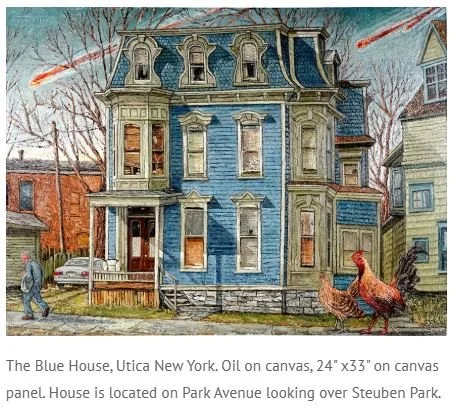
Photo Provided by Roger De Muth
Nearby stood another growing collection that reveals the breadth of his interests. More than one hundred portraits are planned, with approximately twenty already completed. The subjects range from artists, writers, and musicians to public figures whose actions have shaped contemporary culture. Roger isn't interested in producing idealized likenesses. Instead, he looks for expressions that reveal character, a fleeting moment during an interview, a thoughtful pause, a glance that exposes confidence, uncertainty, or contradiction.
Television documentaries, interviews, books, and photographs all become sources. Inspiration often arrives unexpectedly, captured in a freeze-frame before disappearing again. The collection functions less as a hall of fame than as a visual record of the people who have influenced Roger's thinking, challenged his assumptions, or reflected the complicated times in which they lived.
His landscapes reveal a similar concern for documenting change. One large painting in progress depicts farmland in Chittenango gradually giving way to housing developments. Roger has titled it No Country for Old Cows, a quiet commentary on the disappearance of some of New York's richest agricultural land. "We're losing really valuable farmland forever," he said. The painting is about far more than open fields. It asks what is lost when productive farmland becomes subdivisions, and whether progress always requires abandoning the landscapes that once defined a community.
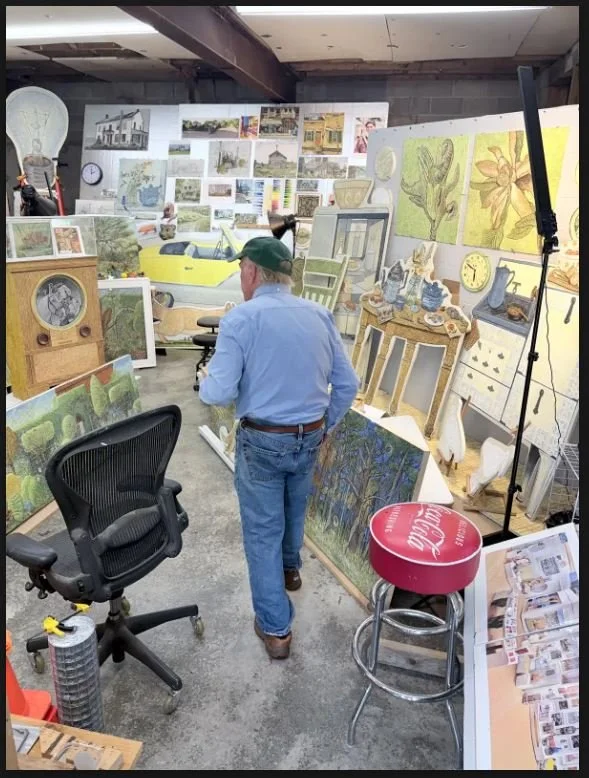
Photo Credit: HonGo David Robertson
For Roger, every painting tells two stories: the one visible on the canvas and the one that history quietly leaves behind. Roger's concern for preserving the past extends far beyond the boundaries of canvas and paper. Painting is simply one expression of a lifelong commitment to documenting places, objects, and traditions before they disappear. Whether he is rescuing an antique frame, researching the history of a farmhouse, photographing a village street, or carving quotations into stone, Roger approaches each project with the same sense of purpose.
That philosophy began taking shape decades ago. After leaving Rochester, Roger and his wife, Naomi, settled in the small New York County village of Nunda. What started as renting an aging farmhouse soon became ownership, ten acres of land, and an education in country living that neither of them could have anticipated. Friends gave the newly married couple a handful of sheep as a wedding present. Before long, the flock had grown to fifty-five. "They were always out on the road," Roger recalled with a laugh. "For some reason, they don't like to stay where they're supposed to be."
Life in Nunda required learning new skills almost daily. Fences had to be repaired. Buildings demanded constant attention. Livestock had to be cared for. More importantly, Roger found himself surrounded by a landscape rich in architectural history and rural traditions. Those years helped shape the artist he would become. Historic homes, old barns, village storefronts, abandoned farms, and the stories connected to them gradually became subjects worthy of preservation rather than simply scenery.
That appreciation for local history soon grew into something larger. Whenever businesses closed or buildings were renovated, Roger often found himself rescuing objects destined for dumpsters. Gold-leaf storefront letters, primitive farm tools, photographs, books, architectural fragments, and historic documents all found temporary homes in his collection, not because he wanted to possess them, but because he believed someone should preserve them.
Eventually many of those artifacts returned to the community through the Nunda Historical Society. "I didn't really want them," Roger explained. "I wanted them because they were throwing them away."
Among the materials he hopes to donate is a remarkable Civil War-era family photograph album filled with tintypes connected to the region. Like so many things Roger has preserved over the years, its greatest value lies not in its rarity but in its ability to tell the story of ordinary people whose lives might otherwise be forgotten.
That same instinct for preservation continues today at his home in Cazenovia. Crossing the road from the studio, Roger invited me to see what he casually calls "the park." The name hardly conveys the amount of thought and labor invested there over the past two decades.
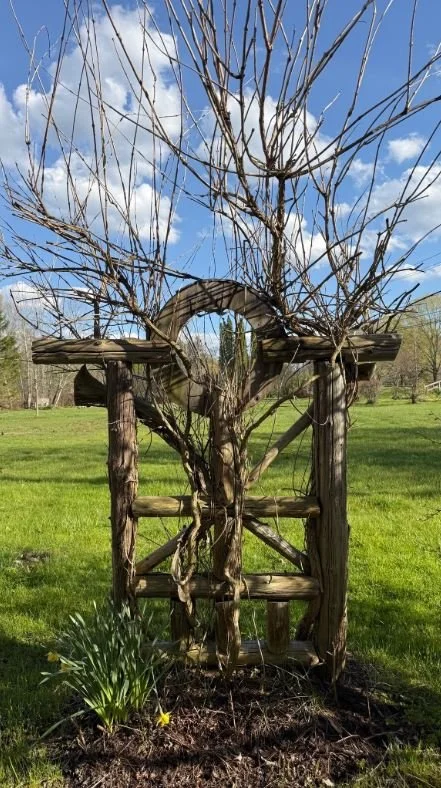
Photo Provided by Roger De Muth
When Roger and Naomi acquired the property, much of it had been bulldozed into piles of brush and neglected woodland. Over the years he transformed it into a landscape of winding paths, gardens, young trees, sculpture, and more than one hundred carved bluestone quotations. The work required far more than gardening.
He located one of the few remaining quarries still cutting bluestone. He learned how to design rubber templates. He found craftsmen capable of precision sandblasting. He experimented with lettering, paint, and stone until every quotation achieved the appearance he envisioned.
Like so many of his projects, the garden became another education, another opportunity to learn unfamiliar skills in pursuit of a larger idea. The quotations themselves reveal Roger's personality. Visitors encounter observations from Mel Brooks, John Cleese, Robin Williams, Fran Lebowitz, and many others alongside reflections about art, creativity, humor, and everyday life. Some quotations provoke laughter. Others invite contemplation. Together they encourage visitors to slow their pace and spend time with both the landscape and the words carved into stone.
"Gardens are for people," Roger said simply. That philosophy guides every aspect of the property. Rather than creating a private retreat, he imagines the space as something to be shared. His long-term hope is that one day the park might become the entrance to a public trail leading toward Cazenovia's Art Park. Although discussions have taken place with local organizations, Roger knows that maintaining public spaces presents challenges as significant as creating them.
Even so, the vision remains. Like the exhibition in his studio, the garden continues to evolve one careful improvement at a time. Walking through the grounds, Roger's enthusiasm shifted effortlessly from sculpture to horticulture. He spoke about layering branches to propagate new trees, experimenting with grafting techniques, and studying the work of artist Sam Van Aken, whose celebrated grafted fruit trees blur the line between agriculture and sculpture. Roger's own experiments are driven less by spectacle than by curiosity. Every successful graft represents another lesson learned.
It is difficult to spend time with Roger without recognizing that curiosity fuels nearly everything he does. If he wants to bind a better sketchbook, he learns bookbinding. If he needs carved stone, he studies sandblasting. If he wants to preserve a landscape, he plants trees. If an exhibition requires display furniture, he designs and builds it himself. Very little is left to chance.
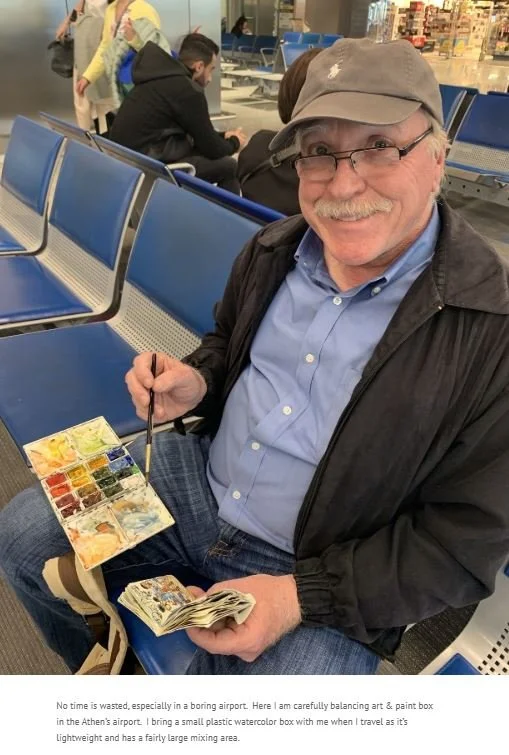
Photo Provided by Roger De Muth
Returning to the house, Roger introduced me to another studio that has developed alongside his own for decades. Upstairs, Naomi De Muth's weaving studio reflects the same commitment to craftsmanship found throughout the rest of their home. Dominating the room is an extraordinary antique loom, believed to date from the late eighteenth or early nineteenth century. Roger remembered searching for months before finally hearing that one might be available near Geneseo. They drove there immediately, brought it home, and it has remained central to Naomi's work ever since. Surrounding the loom are woven rugs, ceramic sculptures, and shelves filled with work prepared for the upcoming Cazenovia Art Trail. Naomi's ceramics are designed to withstand Central New York winters, remaining outdoors throughout the seasons. Her weaving and clay work complement Roger's paintings without ever competing for attention.
Instead, the studios feel like two conversations taking place under the same roof. Different materials. Different techniques. The same respect for craftsmanship.
Roger admitted that he rarely sells many of the paintings connected to his current exhibition. Collectors occasionally ask about purchasing them, but removing major works would weaken the installation he has spent nearly a decade building. "If something happens to me," he joked, "my kids will call you." The exhibition comes first. It is not simply a collection of paintings waiting to be sold. It is one complete work.
Photography has also remained central throughout Roger's career. Documenting architecture and landscapes across New York State and beyond. Today that archive contains hundreds of thousands of carefully organized digital photographs, each preserved through multiple backups after losing weeks of commercial illustration work to an early computer failure.
The photographs serve many purposes. Some become references for paintings. Others document buildings that may no longer exist. Still others preserve small details, a doorway, a storefront, a tree, a stretch of road, that might later find their way into a painting or sketchbook.
Roger photographs for much the same reason he paints. He understands that today's ordinary landscape often becomes tomorrow's history.
As the afternoon drew to a close, we returned to the studio where the visit had begun. The scale model still occupied the worktable. Portraits leaned against unfinished landscapes. Dioramas waited for additional pieces. Giant paintings rested against the walls while handmade sketchbooks filled nearby shelves.
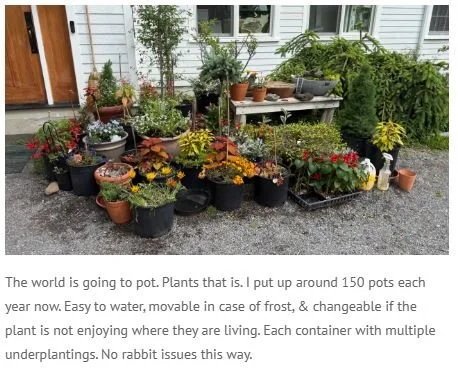
Photo Provided by Roger De Muth
Roger looked around the room, mentally organizing the work still ahead. Display cases remained to be built. Paintings needed framing. Lighting had to be solved. New pieces continued to suggest themselves before older ones were finished.
After eight and a half years, the exhibition is still growing. There was never any sense that Roger viewed this as a burden. Quite the opposite. The next painting, the next sketchbook, the next display, the next solution, those are what continue to draw him back into the studio every morning.
Leaving Roger De Muth's home, I realized the day's conversation had never really been about painting alone. It was about paying attention. It was about preserving what others overlook. His paintings, handmade sketchbooks, photographs, gardens, historical collections, antique frames, and immersive exhibitions all reflect the same belief…that places, objects, and memories matter because they tell the story of who we are.
Roger is, without question, an accomplished painter. But spending time in his studio reveals something larger. He is a builder of experience, an archivist of disappearing places, and a careful observer who understands that history is often preserved not through grand events, but through ordinary objects, familiar landscapes, and the quiet work of someone willing to notice them before they are gone.
For more information:
DeMuth Design site https://www.rogerdemuthdesign.com
Gardens, Ceramics, Videos, Books, Photos:
The Garden site: http://www.rogerdemuthgardens.com
Ceramic site:http://www.rogerdemuthceramics.com
Videos: https://www.youtube.com/user/123rdemuth/videos
Books: http://www.blurb.com/search/site_search?search=De+Muth&filter=all&commit=Search