
Steve Skollar, Inside the Circle and the Living Tradition of Jam Culture
For artist and musician Steve Skollar, music is not about fame, perfection, or performance. It is about participation. It is about showing up with an instrument, sitting in a circle with strangers and friends, listening carefully, and becoming part of something larger than yourself. Over the last two decades, Skollar has immersed himself in what he calls “jam culture,” a loose but deeply meaningful tradition built around communal music-making. What began for him as a late-life fascination with the mandolin eventually evolved into a philosophy about creativity, community, aging, and human connection.
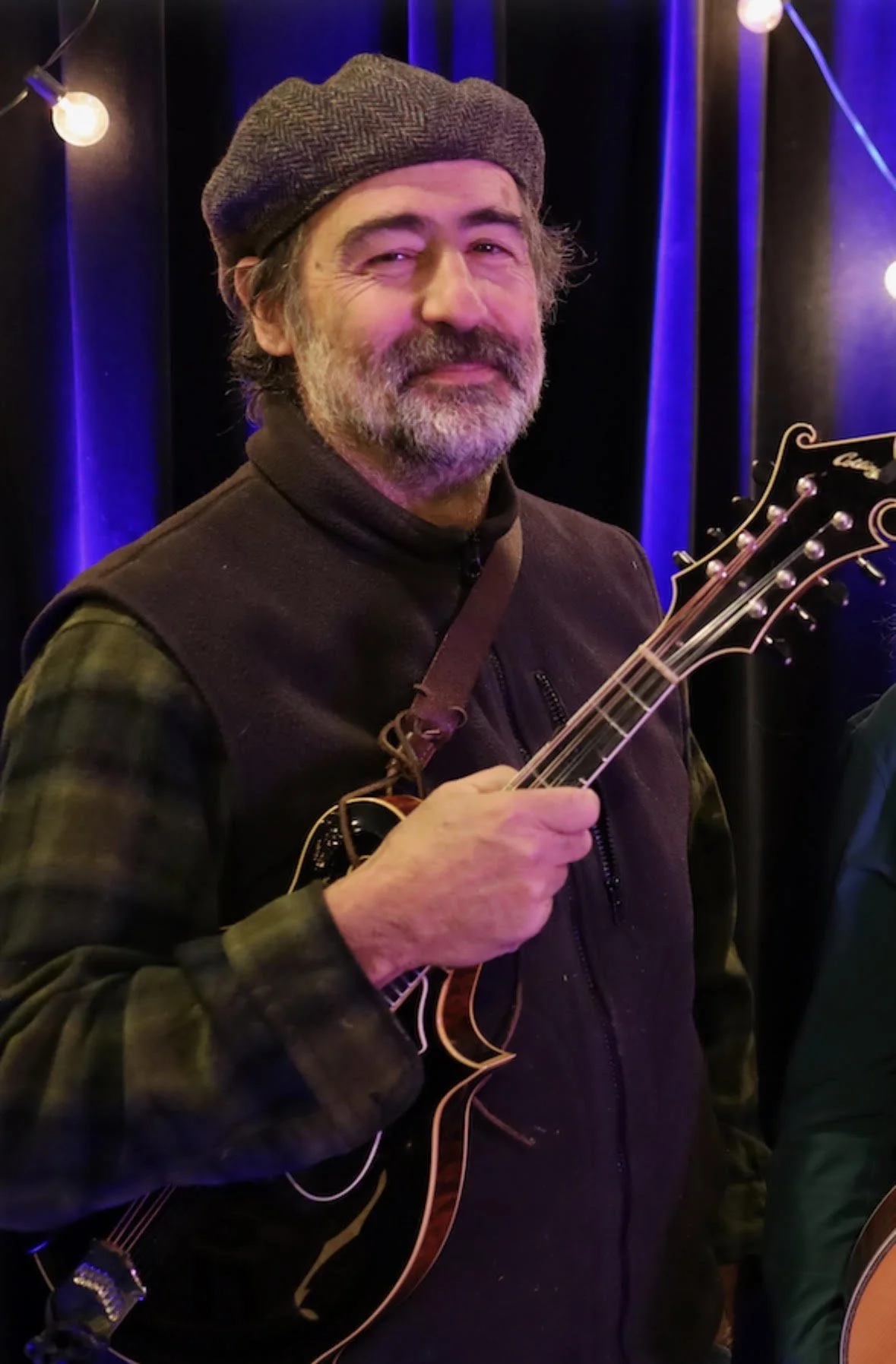
Jam culture exists quietly beneath the surface of American music. It thrives in bars after midnight, in back rooms, living rooms, barns, festivals, coffee shops, and old theaters. It is not commercial. It is not polished. There are no auditions, no ticket sales, and usually no stage. Instead, there is a circle of musicians sharing songs, following one another’s leads, improvising harmonies, and building trust through sound. For Skollar, that world became transformative.
Ironically, Skollar did not grow up around music. His family was deeply artistic, but visually so. “Nobody in my family played any music ever,” he explained. “Everybody was visual artists.” Painting and drawing were familiar territory, but instruments remained mysterious objects sitting outside the family tradition. Even though he always loved music, he struggled to find a way into it. He experimented with guitar and banjo over the years, but nothing truly connected.
Everything changed when he discovered an old Martin mandolin at a garage sale sometime in his mid-forties. The instrument was broken, but something about it immediately clicked. “I always wanted to play music,” he said. “Found this mandolin and boom, took it really seriously.” The small neck suited his hands, and for the first time he felt fully engaged with an instrument.
What followed was an obsession. Skollar practiced constantly, teaching himself chords, melodies, and rhythms. Yet learning the instrument alone was only the beginning. The real education came when he ventured into New York City’s jam scene searching for people to play with. At the time, he was living in Brooklyn and exploring Craigslist listings for local gatherings and bluegrass circles. That search led him to one of the most influential places in his musical life: Sonny’s Bar in Red Hook, Brooklyn.
Sonny’s Bar was an old waterfront establishment overlooking the Statue of Liberty, once a rough longshoreman’s bar owned by generations of Italian-American families. By the time Skollar arrived there, it had become home to a legendary Saturday night bluegrass jam organized by a woman named Tone, whom he described affectionately as “a Norwegian punk.”
The atmosphere inside Sonny’s embodied everything Skollar would come to love about jam culture. Experienced players occupied the center of the circle because they understood the structure of the songs and could guide the music forward. Beginners stayed around the outer edges, listening carefully and contributing where they could. Nobody was humiliated for being inexperienced. Instead, newcomers were welcomed gently into the flow.
Skollar remembered his own nervousness vividly. Walking into Sonny’s for the first time, he feared embarrassment. Then an elderly musician named Irv smiled at him and said simply, “Sit down.” That small invitation opened a door that changed his life.
“That was the best education for playing music I ever had,” Skollar explained. Unlike formal lessons, the jam demanded total engagement. Songs came one after another for hours. There was no stopping to explain chord structures or rehearse arrangements. You learned by listening, adapting, and staying present. “We’d play literally till four in the morning, five in the morning,” he recalled.
The distinction between a jam session and an open mic became central to his thinking. Open mics, he argued, often revolve around individual performers presenting original material while everyone else passively watches. Jam culture operates differently. In a jam, the emphasis is collective rather than individual. People share a common musical vocabulary built from traditional songs and familiar structures. The goal is not self-promotion but collaboration.
Skollar laughed while describing moments when original-song performers would unexpectedly throw complicated stops or changes into an open mic set, leaving everyone scrambling to follow along. “Nobody knows where you’re going,” he said. In a jam session, however, musicians communicate instinctively. They anticipate shifts, support solos, and leave room for one another. The music becomes a conversation rather than a monologue.
That sense of communication fascinates Skollar deeply. He believes the best jams rely on sensitivity rather than technical virtuosity. Good musicians are not necessarily the loudest or flashiest players. Instead, they are people capable of listening carefully and responding in real time. “If you can’t hear the other person,” he said, “you’re playing too loud.”
The nonverbal communication within a jam circle mirrors other forms of artistic collaboration. Musicians exchange subtle signals through eye contact, posture, timing, and dynamics. A glance might indicate the final chorus. A lifted instrument might suggest another solo. The structure remains fluid because everyone is paying attention. “If you’re playing well,” Skollar explained, “you’re gonna look at me and let me know that this is the last time.”
Jam culture also collapses traditional social barriers. Age differences disappear. Professionals play beside beginners. Elderly musicians sit next to college students. Skollar remembered one young woman who wandered into Sonny’s shyly after arriving in Brooklyn for college. Years later, she had become a touring musician performing across the country. Jam sessions allowed her to grow organically within a supportive environment.
“The whole thing is really inclusive,” Skollar said repeatedly. That inclusiveness remains one of the culture’s defining features. Unlike competitive music scenes driven by commercial ambition, jam circles often prioritize generosity. Skilled musicians help less experienced players improve simply by bringing them into the music.
As Skollar spent more time in these circles, he began organizing jams himself. After moving full-time to upstate New York following the COVID-19 pandemic, he noticed that rural musical culture differed from Brooklyn’s dense late-night scene. There were fewer ongoing jams and less of a nightlife infrastructure, but there was still a hunger for connection.
So Skollar started hosting gatherings in bars, homes, and local venues around Hamilton and Earlville. Sometimes only four or five musicians would attend. Other nights twenty people would show up carrying fiddles, guitars, banjos, mandolins, and upright basses. The sessions remained informal and open-ended. Musicians drifted in and out of the circle naturally.
These gatherings often led to unexpected collaborations. Someone might discover a talented bass player during a jam and later invite them into a band. Another player might emerge as a strong harmony singer or fiddle accompanist. Jam culture has become both a social network and an incubator for future musical projects.
One musician particularly affected by this environment was Henry Howard, Director of Arts at the Palace in Hamilton. Howard, a songwriter Skollar frequently referenced during the conversation. Before discovering jam sessions, Henry primarily wrote and played alone. Jam culture gave him something different: interaction. It pulled him back into music by replacing isolation with community.
Skollar believes this communal aspect matters profoundly today, especially in an era dominated by digital communication and social fragmentation. Jam sessions create real-time human interaction without screens, algorithms, or performance metrics. People gather physically in the same space and focus entirely on listening to one another.
The culture even survived disasters. Skollar recalled how Sonny’s Bar suffered severe flooding during Hurricane Sandy. The building temporarily closed, but the jam continued unofficially in the back room through side entrances. Musicians still showed up because the gathering itself mattered more than the business operation around it. “It was like a speakeasy,” he remembered.
COVID-19 disrupted that world again years later, forcing many musicians apart. Yet the pandemic also pushed Skollar into a different phase of life. He relocated permanently upstate and began reassessing how he wanted to spend his remaining years. Approaching seventy, he now views music less as ambition and more as nourishment.
“There are times now where I’ll say I’ve got three hours and I want to do that,” he explained. The urgency of youth has softened into something more intentional. He no longer worries much about legacy or recognition. What matters now is enjoyment, connection, and meaningful use of time.
Jam culture fits naturally into that philosophy because it values presence over permanence. A jam session exists only in the moment. No recording fully captures it. No audience necessarily witnesses it. The reward comes from participation itself, the feeling of falling into rhythm with others and contributing to a shared sound.
For Skollar, the mandolin became the perfect instrument for this role. Unlike front-facing singer-songwriters, he prefers being a sideman, adding texture and harmony rather than dominating attention. “Just tinkle around where they’re not,” he joked, describing the subtle art of accompaniment.
In many ways, that statement captures the spirit of jam culture itself. The goal is not to overpower the circle but to support it. To listen more than speak. To know when to step forward and when to step back. To understand that music, at its best, is a communal act rather than an individual achievement.
As the conversation drew to a close, Skollar reflected on aging, creativity, and mortality with surprising calmness. Friends have died. Relationships have ended. Time feels more visible now than it once did. Yet instead of becoming bitter or nostalgic, he seems increasingly focused on enjoyment and gratitude. “As long as we’re having fun doing it,” he said, “that’s enough.”
Inside the jam circle, that philosophy becomes audible. There are no stars there, only players listening for the next chord change together.