
Sherry Spann Allen: Inside the Studio of Form and Space
A gray April morning in Syracuse, “a great day for taking photos,” Spann Allen offers. The light filters softly through tall industrial windows inside the Delavan Center, settling across a studio filled with layered textures, cut wood, painted surfaces, and works in progress. The space belongs to artist Sherry Spann Allen, who has spent decades navigating abstraction, education, and material exploration. She works comfortably within that space part workshop, part sanctuary, ready to talk not just about her work, but about the long, winding path that led her here.
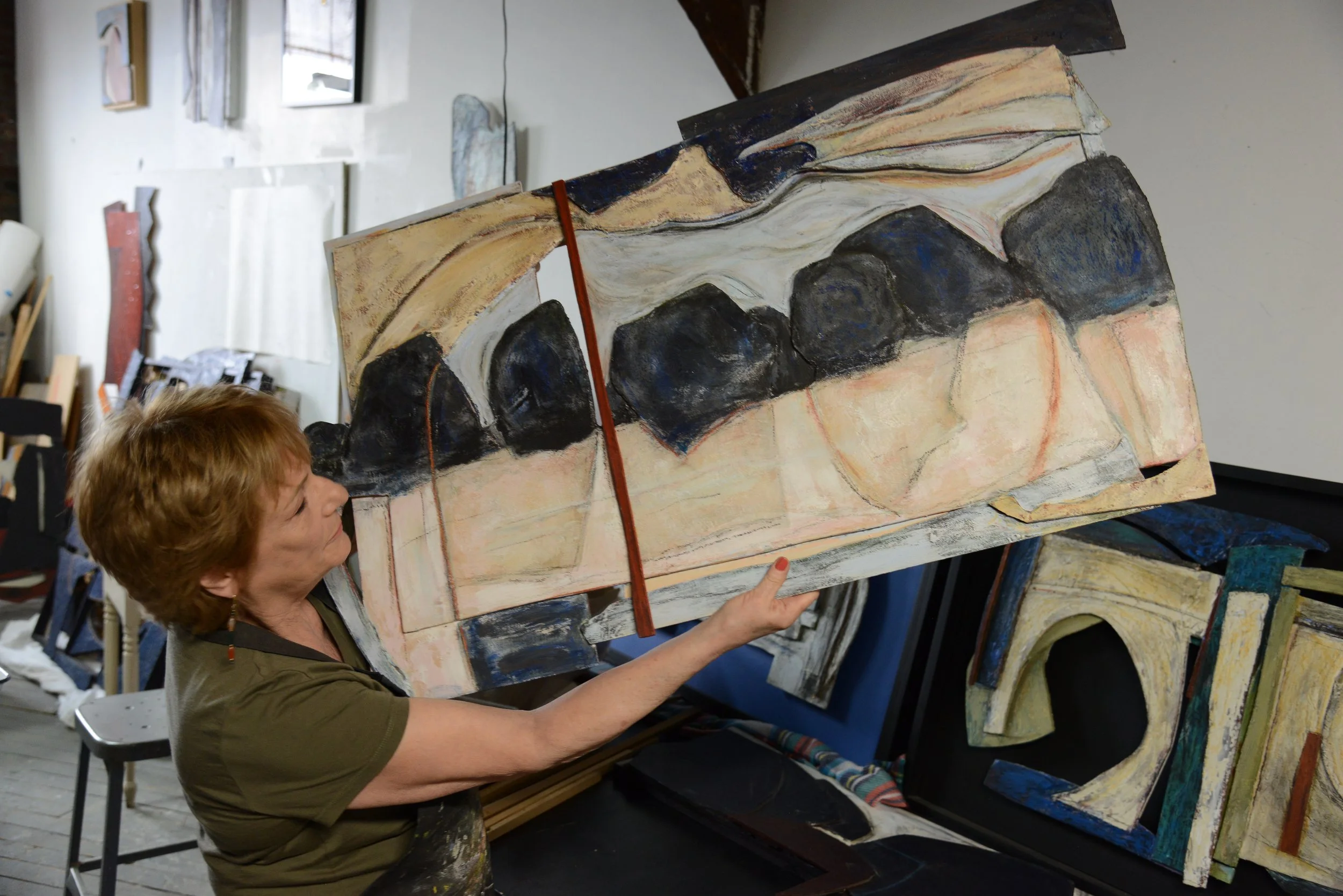
Sherry Spann Allen painting, “Firth of Fourth”. Photo Credit: Hongo David Robertson
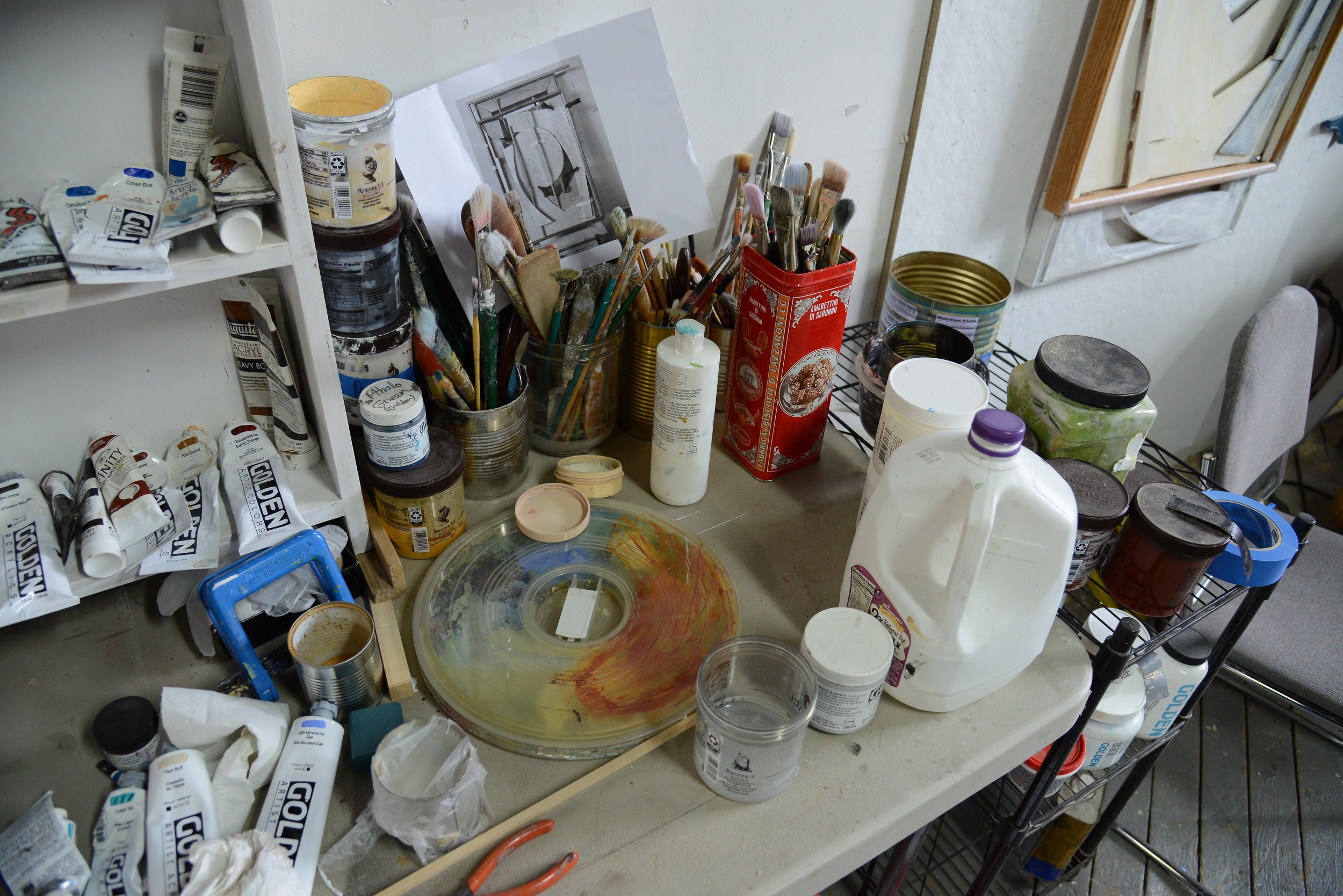
Allen has been working out of her Delavan Center studio for nearly a decade. The move came shortly after her retirement from a 30-year career as a high school art teacher in Chittenango. For years, she had hoped to secure a space in the building, a former warehouse turned creative hub for artists across disciplines. “I had been trying to get in here for a few years,” she explains. “There just wasn’t anything available. Then the timing worked out.” That sense of timing of waiting, watching, and eventually stepping into the right moment mirrors her artistic process. Nothing is rushed. Everything evolves. The studio itself reflects that evolution. It’s not pristine or overly organized; instead, it hums with activity. Materials are stacked, partially assembled pieces lean against walls, and surfaces carry the marks of experimentation. For Allen, this is not clutter its possibility. “This is what it’s supposed to look like,” she says. “I don’t want to clean it up if I don’t have to. It’s a working space.”
Before moving into the Delavan Center, Allen worked out of a home studio, a separate garage that, while functional, came with limitations. It wasn’t well heated, which made year-round work difficult. Supplies had to be moved in and out with the seasons. The space, though physically separate, didn’t provide the mental distance she needed. “I have to get away from the house,” she says. “Otherwise, I get distracted.” The studio offers something different: focus, discipline, and a sense of purpose. She compares it to going to a gym not because of obligation, but because of intention. “When you go somewhere specifically to do something, it changes your mindset,” she explains. Even so, her approach to time in the studio remains fluid. Some days she works for hours; others, she steps away entirely. The rhythm is intuitive rather than rigid. “If I’m really into something, I’m drawn here,” she says. “If not, I don’t force it.”
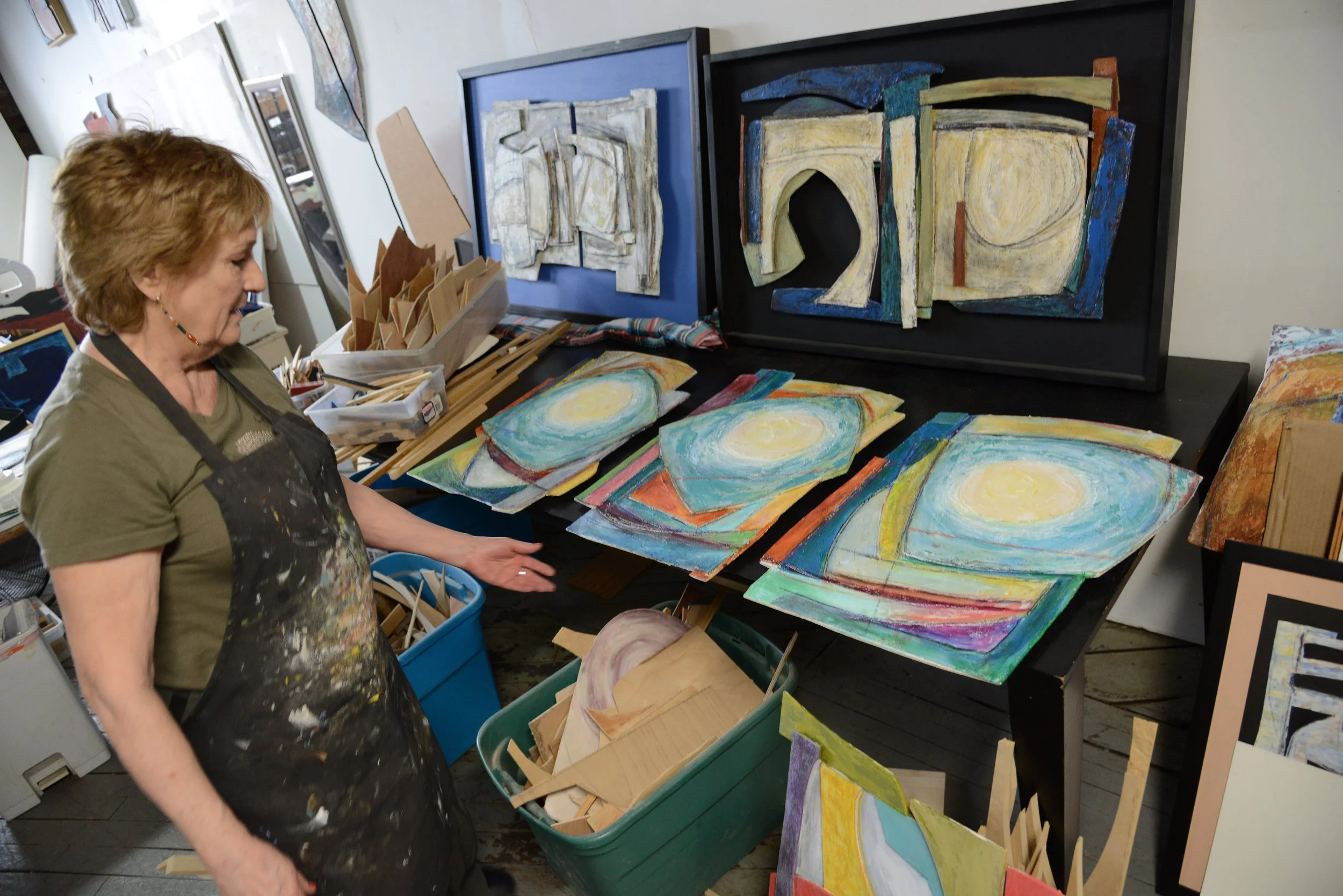
Sherry Spann Allen painting, “Yesterday, Today and Forever”. Photo Credit: Hongo David Robertson
Allen grew up in North Syracuse, a place she describes as “pretty boring.” But within that quiet environment, something important took root: time. “I had a lot of time to myself,” she says. “I was always making things.” Those early acts of making were not driven by instruction or expectation. They were instinctively finding materials, manipulating them, exploring their possibilities. She recalls working with wood as a child -- planing a beam simply for the satisfaction of shaping it. “It was methodical,” she says. “Relaxing.” That tactile engagement with materials would later become a defining element of her work.
After high school, Allen’s path was anything but direct. She took time off, in part to pursue another passion: skiing. Her family was deeply involved in the sport, and for a time, she was as well. But practicality eventually led her back to academics. She began at Onondaga Community College, studying studio art before transferring to Syracuse University. There, she initially entered a program focused on fabric design now known as surface pattern design. “I realized there wasn’t enough illustration,” she says. “I needed something broader.” She moved into a program called synesthetic education, an experimental, multisensory approach to art education that emphasized cross-disciplinary learning. Though the program no longer exists in its original form, it left a lasting impression. “It was fascinating,” she says. “Art experienced through multiple senses.” Still searching for the right fit, she eventually shifted again this time to painting. The decision was partly practical, switching to sculpture would have extended her time in school. But painting, she discovered, offered a flexibility that suited her. “I think of myself as a sculptural painter,” she says. “Even when I’m working on a flat surface, I’m thinking about form and space.” She later earned a master’s degree in art education, also from Syracuse University, setting the stage for a long career in teaching.
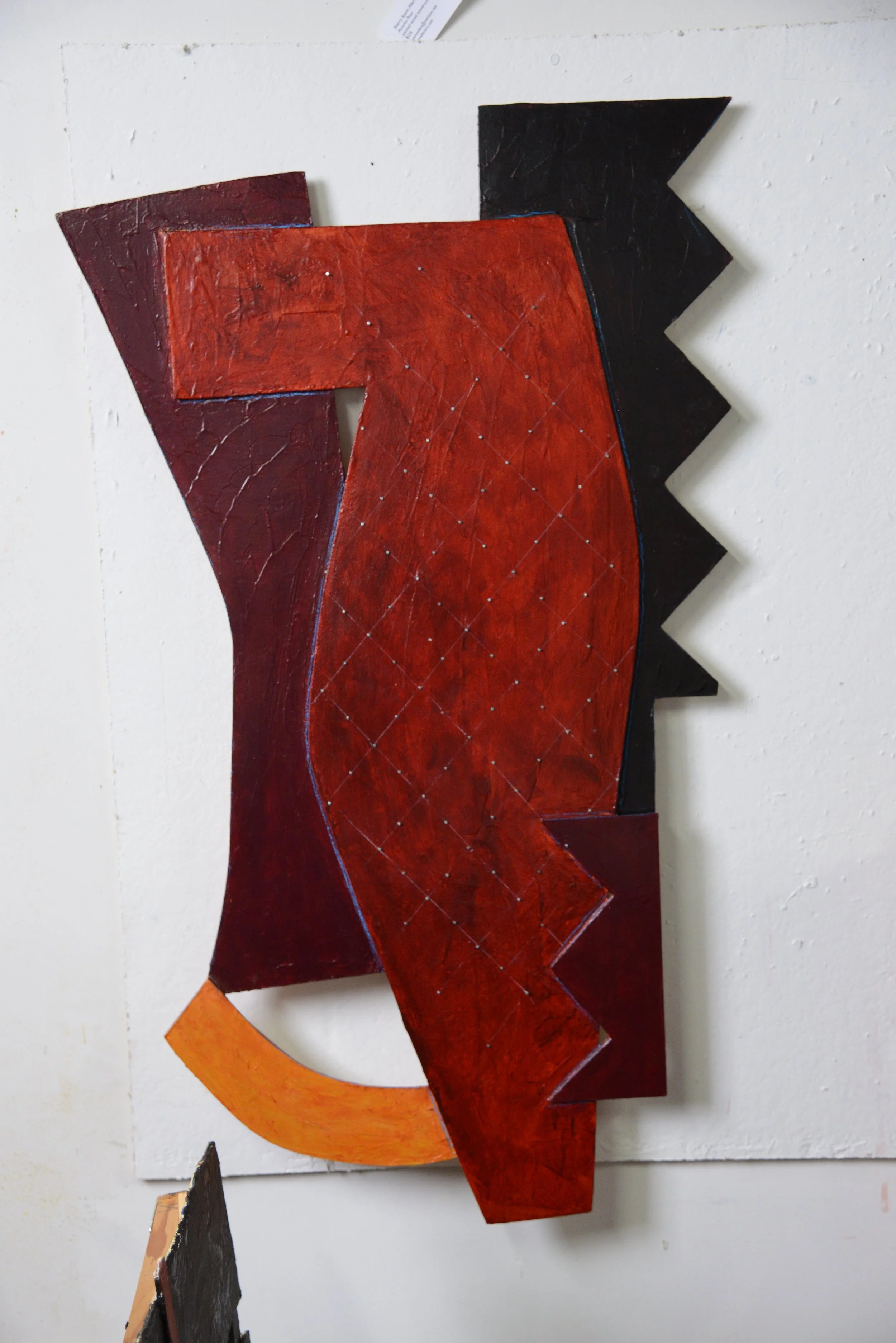
Sherry Spann Allen painting, “African Beauty”. Photo Credit: Hongo David Robertson
Allen began teaching shortly after completing her graduate studies, first in Fabius-Pompey and then in the Chittenango school district, where she remained for 30 years. “It worked out,” she says. “Even though I jumped around a bit early on.” Her varied educational background proved to be an asset. Rather than focusing narrowly on one medium or style, she brought a wide range of influences into the classroom. “I think it made me a better teacher,” she says. “I could expose students to different ways of thinking.” One of her priorities was introducing abstraction, something that wasn’t always emphasized in traditional art curricula. “That was one of my favorite things to teach,” she says. “Helping students see that art doesn’t have to be literal.” Encouragement, she notes, was critical in her own development. She credits mentors like her high school teacher, Dick D’Angelo, and college professor Michael Sigler with recognizing her potential and supporting her direction. “They understood what I was trying to do,” she says. “That matters.”
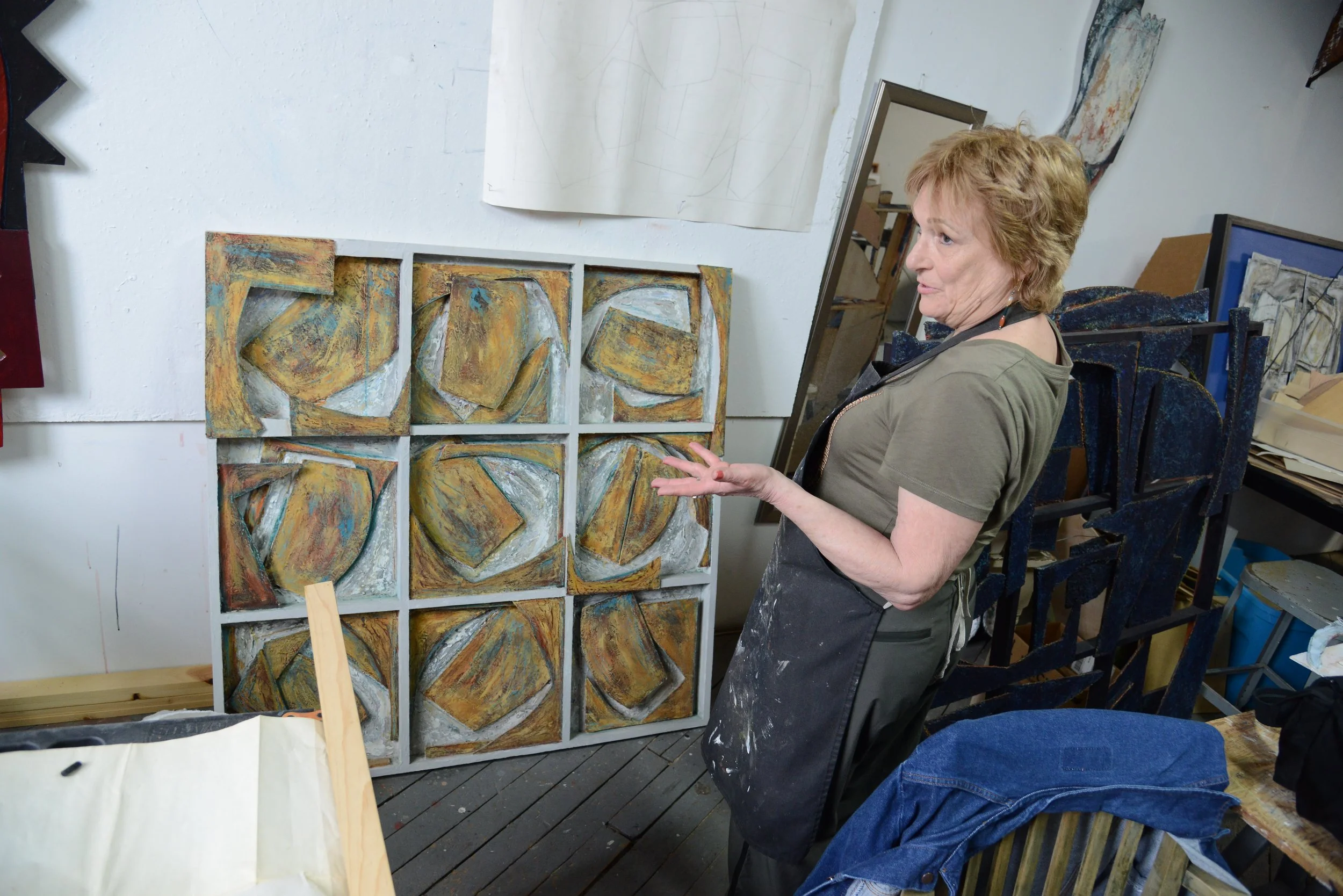
Sherry Spann Allen painting, “Journey”. Photo Credit: Hongo David Robertson
Like many artists, Allen’s routine shifted during the COVID-19 pandemic. But unlike those confined to their homes, she retained access to her studio, a factor that significantly shaped her experience. “I was actually more disciplined then,” she says. “I spent longer hours here.”
One piece from that period, which she refers to as her “journey” piece, reflects that time. It’s complex, layered, and deeply process-driven. “I don’t work literally,” she explains. “It’s about design shape, space, relationships.” The pandemic, in that sense, reinforced her commitment to abstraction rather than altering it.
Allen’s creative process resists strict planning. While she occasionally sketches, especially while traveling, most of her work develops organically. “I might start with something I find,” she says, gesturing to a stack of old frames and materials. “I like using what’s already there.” Negative space plays a central role. She builds compositions by balancing presence and absence, often allowing empty areas to guide the structure of the piece. “I’m always thinking about how space interacts,” she says. She frequently photographs her work in progress, using those images to gain perspective. “I’ll see something in the photo that I didn’t notice before,” she explains. “Then I come back and adjust.” Stepping away is essential. Solutions often emerge not in the act of working, but in the pause between sessions. “I need that distance,” she says.
Though much of her work is solitary, Allen is not isolated. The Delavan Center houses a community of artists, and that proximity has influenced her practice in unexpected ways. “I’ve learned a lot from people here,” she says. From maintenance staff showing her how to use tools to neighboring artists sharing techniques, the environment fosters informal collaboration. She has expanded her skill set to include woodworking tools like routers and circular saws skills she once found intimidating. “If someone shows you how to do it safely, it makes all the difference,” she says. She also values feedback from trusted individuals, including her former husband, a musician and artist. “He has a great eye,” she says. “Sometimes he’ll suggest something small, and it changes everything.”
Allen primarily works with acrylic paint, often incorporating textural elements through pastes and layered surfaces. She cuts, assembles, and reconfigures materials, sometimes dismantling completed works to create new ones. “If something’s not working, I’ll cut it up,” she says. “And sometimes the smaller pieces are better.” Her work sits at the intersection of painting and sculpture, blurring the boundaries between the two. “I’m always experimenting,” she says.
Music, particularly jazz, plays a significant role in Allen’s creative life. She describes herself as a “good listener” and frequently attends live performances in the Syracuse area. “I love jazz because it’s improvisational,” she says. “That’s how I work.” The parallels are clear: both jazz and her art rely on structure but thrive on spontaneity. Both require attentiveness and a willingness to respond in the moment. “It’s about feeling your way through,” she says.
One of Allen’s ongoing frustrations is the tendency of viewers to search for literal meaning in her work. “I don’t understand why people need to see something specific,” she says. While she acknowledges that certain shapes may suggest figures or forms, she resists defining them. “It might start from something real,” she says, “but I don’t want it to stay there.” Instead, she encourages viewers to engage with the work on its own terms through color, shape, and spatial relationships rather than narrative. “Just experience it,” she says.
Allen continues to exhibit her work, though selectively. She submits to juried shows and has shown in regional galleries, including spaces outside Syracuse. However, she is mindful of where and how her work is displayed. “Lighting matters,” she says. “Presentation matters.” She has moved away from venues that don’t provide optimal conditions, such as poorly lit library spaces. Sales, she notes, can be challenging particularly for abstract work. “People want something recognizable,” she says. “But I’m not going to change what I do.”
Toward the end of the conversation, Allen reflects on a broader question: what constitutes art? “I think art can be anything,” she says. “It depends on how it’s approached.” She recalls debating this idea with a professor who questioned her expansive definition. Her response was simple: creativity exists in many forms, whether in visual art, music, or even everyday acts. For Allen, art is less about category and more about intention. Back in her studio, that philosophy is evident everywhere in the unfinished pieces, the layered surfaces, the willingness to experiment and revise. Nothing is fixed. Everything is in progress. And that, she suggests, is exactly as it should be.